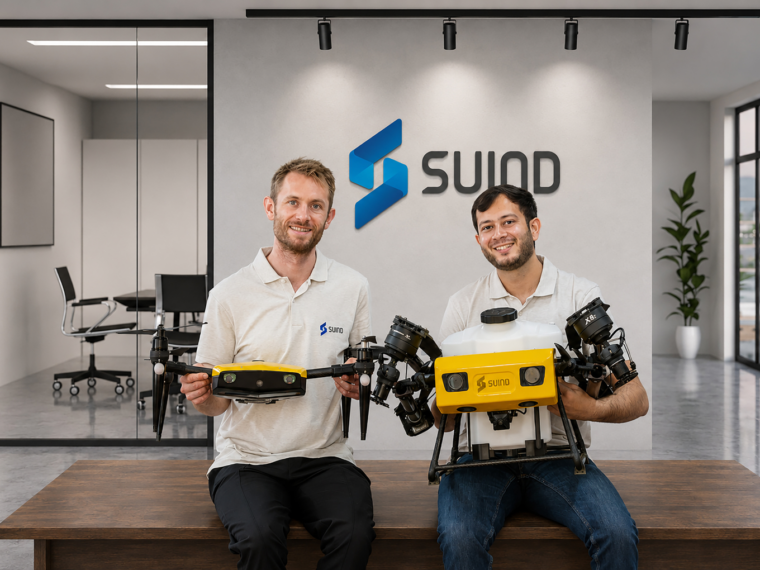
SUIND’s ₹20.5 Crore Funding Push Signals A New Era For Autonomous Surveillance Drones
A Fresh Investment Changes The Conversation
India’s drone technology industry keeps finding new reasons to attract attention, and this latest funding announcement adds another interesting chapter. SUIND has secured ₹20.5 crore in fresh investment to strengthen its autonomous surveillance drone development. That amount is not just another funding headline because it reflects growing confidence in India’s defense and industrial technology ecosystem. Investors usually place money where they see long-term potential, and autonomous aerial systems are becoming one of those promising spaces.
The company plans to improve drone intelligence, automation, and surveillance capabilities instead of focusing only on hardware. That approach makes sense because modern drones are expected to think faster, collect smarter data, and operate with minimal human involvement. The funding could accelerate those goals much sooner than expected.
Why Autonomous Surveillance Drones Matter Today
Traditional drones often require continuous human control during missions, which naturally limits their efficiency. Autonomous surveillance drones work differently because they can navigate planned routes, avoid obstacles, monitor designated areas, and return safely with very little operator intervention. That saves both time and manpower in demanding environments.
Governments, industrial companies, infrastructure operators, and emergency response agencies increasingly rely on autonomous aerial systems for daily monitoring tasks. These machines reduce operational risks while covering much larger geographical regions within shorter periods. As artificial intelligence improves, these drones continue becoming smarter and more dependable.
This growing demand explains why investors are beginning to support companies developing advanced surveillance technologies rather than basic flying platforms.
Funding Reflects Strong Market Confidence
Raising ₹20.5 crore during today’s competitive startup environment is not something that happens by accident. Investors carefully examine technology readiness, commercial opportunities, management capabilities, and future scalability before committing significant capital.
SUIND appears to have convinced investors that autonomous surveillance represents an expanding market rather than a temporary trend. Security concerns continue increasing worldwide, while industries also require constant monitoring of pipelines, power stations, highways, forests, and manufacturing facilities.
Funding allows technology startups to move beyond prototypes and develop products capable of serving large commercial customers. That transition often separates successful companies from those that struggle after initial innovation.
Artificial Intelligence Becomes The Real Engine
Many people still think drones are simply flying cameras, although reality has changed dramatically during recent years. Modern surveillance platforms increasingly depend upon artificial intelligence for navigation, object recognition, route planning, and decision making.
AI enables autonomous drones to identify unusual activities, classify moving objects, recognize infrastructure defects, and prioritize critical observations without waiting for human instructions. Those capabilities dramatically improve operational efficiency while reducing response times.
Machine learning algorithms continue improving after every completed mission. That means future surveillance drones could become significantly more accurate than earlier generations, making them valuable across multiple industries.
Security Applications Continue Expanding
Defense remains one obvious application for autonomous surveillance drones, but it certainly is not the only one. Border security organizations can monitor difficult terrain continuously without exposing personnel to unnecessary risks. Large industrial facilities benefit from automated inspections throughout extensive operational areas.
Critical infrastructure including oil pipelines, railway corridors, electrical transmission networks, and communication towers also require regular surveillance. Autonomous drones complete those inspections much faster than conventional manual methods while producing highly detailed visual data.
Natural disaster management creates another practical opportunity. Emergency responders often need immediate aerial visibility after floods, earthquakes, or landslides. Autonomous drones can quickly survey dangerous locations where human access remains difficult or unsafe.
Indian Drone Industry Keeps Growing Faster
India’s drone ecosystem has experienced remarkable momentum during the past few years. Government policies encouraging domestic manufacturing, technological innovation, and defense modernization have created favorable conditions for startup growth.
Several young companies now specialize in agriculture, logistics, mapping, industrial inspection, and surveillance solutions. Competition continues increasing, although healthy competition often drives better innovation and lower operational costs.
Funding announcements like SUIND’s demonstrate that investors recognize India’s ability to build globally competitive drone technologies instead of depending entirely upon imported systems. Domestic innovation also strengthens national technological independence over time.
Technology Development Needs Serious Investment
Building reliable autonomous surveillance systems requires much more than assembling electronic components. Engineers spend years improving flight stability, battery performance, navigation software, communication systems, onboard sensors, and cybersecurity protections.
Research and development demands consistent financial support because advanced drone technologies evolve rapidly. Companies unable to invest continuously often struggle against competitors introducing better capabilities every year.
Fresh funding gives SUIND greater flexibility to expand engineering teams, purchase testing equipment, refine software platforms, and accelerate commercial deployment. These investments often produce long-term advantages rather than immediate financial returns.
Commercial Opportunities Extend Beyond Defense
Many businesses outside defense increasingly recognize the value of autonomous surveillance technology. Mining companies monitor large excavation sites more efficiently through automated aerial inspections. Renewable energy operators inspect solar farms and wind turbines without lengthy manual processes.
Agricultural organizations use surveillance drones to examine crop health across massive fields. Smart cities explore aerial monitoring for traffic management, infrastructure maintenance, and emergency response coordination.
Insurance companies occasionally utilize drone inspections after natural disasters to estimate damages more accurately and process claims faster. These commercial opportunities significantly expand the potential customer base for advanced drone manufacturers.
Challenges Still Cannot Be Ignored
Despite impressive progress, autonomous drone companies continue facing meaningful challenges. Battery limitations still affect flight duration, especially during complex surveillance missions covering extensive territories. Weather conditions sometimes reduce operational reliability despite continuous engineering improvements.
Regulatory compliance also remains essential because airspace safety requires careful coordination between government authorities and drone operators. Companies must satisfy strict certification requirements before deploying advanced autonomous systems commercially.
Cybersecurity presents another important consideration. Connected drones transmit sensitive information, making secure communication systems essential for protecting surveillance data against unauthorized access.
Overcoming these obstacles requires patience, technical expertise, and sustained financial investment rather than quick solutions.
Competition Could Drive Better Innovation
The autonomous surveillance market continues attracting startups alongside established aerospace companies. That competition may initially appear challenging, although it usually encourages faster technological improvement and healthier product development.
Companies constantly improve flight endurance, artificial intelligence accuracy, navigation reliability, sensor quality, and operational safety to differentiate themselves. Customers ultimately benefit because they receive better products offering stronger performance and greater reliability.
Innovation cycles become shorter whenever multiple organizations compete within rapidly developing technology sectors. SUIND will likely continue refining its offerings to remain competitive while expanding commercial partnerships.
Looking Ahead At The Future
Autonomous surveillance drones are gradually moving from specialized defense equipment toward mainstream operational tools serving numerous industries. Advances in artificial intelligence, lightweight materials, satellite navigation, and battery technology continue making these systems increasingly capable every year.
SUIND’s recent funding could represent an important milestone if the company successfully transforms investment into commercially successful products. Investors clearly believe the opportunity exists, although execution ultimately determines long-term success.
As demand for automated monitoring solutions keeps growing, companies developing intelligent drone technologies may play an increasingly significant role within India’s expanding innovation ecosystem.
Conclusion
SUIND securing ₹20.5 crore for autonomous surveillance drone development highlights growing confidence in India’s advanced technology sector. The funding represents much more than additional capital because it supports research, engineering, product development, and future commercial expansion. Autonomous surveillance continues finding applications across defense, infrastructure, agriculture, disaster management, and industrial operations. Although technical and regulatory challenges remain, industry momentum appears stronger than ever before. Companies capable of combining reliable hardware with intelligent software are likely to shape the next generation of aerial monitoring solutions. Watching SUIND’s progress over the coming years will certainly provide valuable insight into how India’s drone ecosystem continues evolving.
Read More :-