AI Could Unlock Animal Communication by 2030
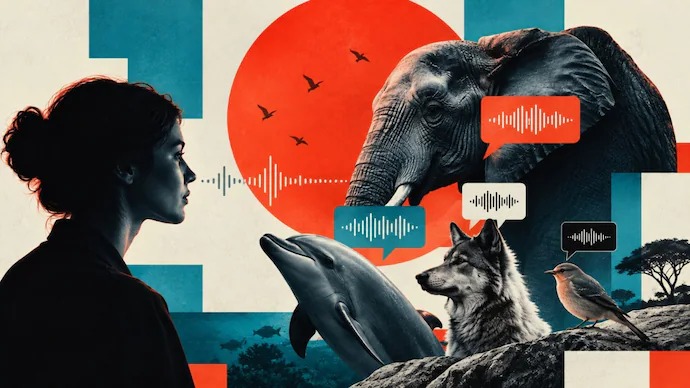
For centuries, humans have wondered whether animals are trying to tell us something through their calls, movements and behaviour. A bird singing from a tree, a whale producing complex sounds underwater or a wolf howling across a forest may appear simple to people, but scientists believe these signals could contain far more information than humans currently understand.
Now, advances in artificial intelligence are bringing a surprising possibility closer. Researchers working on animal communication believe AI could eventually help humans interpret animal signals and potentially create a form of two-way communication by around 2030. The idea still sounds futuristic, but improvements in machine learning, data collection and animal tracking are giving scientists tools that were unavailable just a few years ago.
The goal is not necessarily to make animals speak human languages. Instead, researchers are trying to understand the patterns hidden inside the sounds and behaviours animals already use. If successful, AI animal communication could become an important scientific breakthrough while also raising difficult questions about privacy, conservation and human responsibility.
AI Is Learning Animal Communication Patterns
The basic concept behind this research is relatively straightforward. Animals continuously produce sounds and signals, but humans usually struggle to understand their meaning because there is simply too much information to analyse manually.
Artificial intelligence could change that process by examining enormous collections of animal sounds and identifying repeated patterns. Machine learning systems can compare calls, situations, movements and environmental conditions to determine whether particular signals appear connected to specific behaviours.
Scientists are also using small electronic devices known as biologgers. These devices can be attached to animals and collect information about sounds and activity. Depending on the species being studied, the recordings could include whale songs, bird calls, wolf howls and other forms of communication.
The larger the dataset becomes, the more opportunities researchers have to identify relationships that may be invisible to human observers.
The Dream Goes Back Thousands Of Years
Although artificial intelligence has given the idea new momentum, humans have been fascinated by animal communication for a very long time.
Archaeological discoveries have even suggested that ancient humans may have used instruments to communicate with birds such as falcons. Researchers have found bone flutes estimated to be around 12,000 years old, adding another interesting chapter to the long history of human attempts to interact with other species.
Modern science later approached the question more systematically. Animal psychologist Irene Pepperberg spent decades studying an African grey parrot named Alex, whose abilities became important in research into animal intelligence and communication.
Primatologist Jane Goodall also famously studied chimpanzees and their social behaviour, helping demonstrate how complex animal interactions can be.
What has changed today is the amount of data researchers can collect and the computing power available to process it.
Why 2030 Has Become Important
The year 2030 is increasingly being discussed as a possible milestone for AI animal communication, although it should not be interpreted as a guaranteed deadline.
Jeremy Coller, a major financial supporter of research in this area, has expressed confidence that scientists could make a major breakthrough by 2030. His prediction reflects the rapid pace at which AI systems are improving rather than a confirmed scientific timetable.
Modern AI models are increasingly capable of recognising patterns across huge datasets. The same basic capability that allows machines to process human speech, images and text could potentially be adapted for animal sounds.
However, decoding a signal is not the same as proving its meaning.
Researchers would need to establish that an AI-generated interpretation consistently matches an animal’s behaviour and circumstances. Otherwise, a system could simply be detecting correlations without actually understanding what an animal intends to communicate.
Birds And Whales Could Offer Clues
Different species communicate in very different ways, so there may never be one universal animal translator.
Birds could be an important area of research because many species use repeated vocalisations in social situations. Crows, in particular, are known for sophisticated behaviour and communication, making them interesting candidates for machine-learning studies.
Whales are another major focus because their underwater vocalisations can be extremely complex and travel across considerable distances.
AI could potentially analyse thousands or millions of these sounds and compare them with information about location, group behaviour, age, environmental conditions and other factors.
Over time, researchers could begin identifying patterns associated with danger, food, social interaction, movement or other situations.
That would be very different from simply translating an animal call into a human sentence. Instead, the technology could provide a probable interpretation based on evidence collected from repeated observations.
Conservation Could Gain A Powerful Tool
One of the biggest potential benefits of decoding animal communication is conservation.
Understanding what animals are communicating could help scientists identify stress, threats or changes in their environment much earlier. If certain calls consistently appear when animals encounter predators, human activity or environmental disturbances, researchers could potentially use those signals as an early warning system.
The technology might also improve our understanding of animal social structures.
Better communication research could reveal how groups coordinate movement, protect young animals, find food or respond to changes in their surroundings.
Supporters of the research believe that greater understanding could also change how humans think about wildlife. If people gain a clearer picture of animal behaviour and emotions, they may become more concerned about habitat destruction, climate change and practices that negatively affect animals.
The Technology Could Also Be Misused
The most interesting part of this development is also one of the most worrying.
If humans learn how to interpret animal communication, there is no guarantee that everyone will use that knowledge for conservation or scientific research.
History provides several examples of humans turning animal communication techniques into hunting tools. Whalers have previously used sonar technology to influence whale behaviour, while hunters and poachers have used recorded bird calls to attract birds toward traps.
An advanced AI system could potentially make such methods far more sophisticated.
For example, if researchers discover that a particular crow call signals safety or food, someone could theoretically reproduce that signal to manipulate birds. A technology designed to understand animals could therefore become a tool for exploiting them.
This is why researchers face a difficult question before the technology becomes widely available: should every discovery about animal communication be openly released?
Animal Privacy May Become A Real Debate
There is another issue that may sound unusual today but could become important in the future: animal privacy.
Humans generally think of communication as something that can be studied and recorded freely when it involves wildlife. But if scientists eventually demonstrate that some animals have complex social communication, the ethical debate could become much deeper.
Imagine an AI system capable of detecting what a group of whales is discussing or identifying social information from a flock of birds.
Would researchers have the right to broadcast their calls back to them?
Could tourists use such technology?
Should companies be allowed to develop commercial animal translators?
These questions become particularly important if communication technology changes animal behaviour rather than simply observing it.
Talking To Animals May Not Mean Speaking Human Words
The phrase “talking to animals” can create the impression that humans will soon have conversations with dogs, whales or birds using ordinary spoken language.
Reality is likely to be much more complicated.
Animals have different brains, senses, social structures and communication systems. Their signals may not represent words in the same way human languages do.
An AI system might therefore produce something closer to an interpretation such as “warning nearby” or “food detected” rather than translating a long animal conversation into perfect English.
That distinction matters because scientists still need to determine how much of animal communication represents deliberate messages and how much is instinctive behaviour.
A Major Scientific Breakthrough With Risks
The possibility of AI animal communication by 2030 is exciting because it could change the relationship between humans and other species. Instead of simply observing animals from a distance, scientists may eventually understand parts of the communication systems that have remained mysterious for generations.
But the technology should not be treated as a guaranteed animal translator arriving in 2030.
The prediction depends on major scientific breakthroughs, reliable datasets and careful validation. Researchers must also make sure AI does not invent meanings that animals never intended.
More importantly, any successful system would need strong ethical boundaries.
The real achievement may not be simply teaching machines to recognise animal signals. It could be learning how to use that knowledge without disturbing, manipulating or exploiting the creatures being studied.
If scientists manage that balance, AI could become more than another powerful technology. It could give humans an entirely new way to understand the natural world while encouraging greater respect for the species that share it with us.
Read More :- mopandpail.com