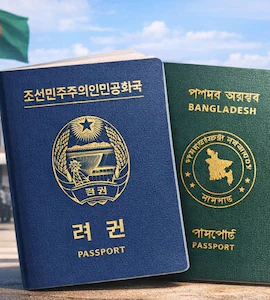
Bangladesh Grants Visa-on Arrival to North Koreans
In a surprising diplomatic development, Bangladesh has allowed visa-on-arrival access to passport holders of North Korea, one of the most isolated countries in the world. The move has generated global interest because international travel access for North Korean citizens remains extremely limited. For a passport that consistently ranks near the bottom in global mobility indexes, any new entry point represents a notable shift.
While visa policies are often routine administrative decisions, this announcement stands out because it involves a nation whose citizens face some of the strictest travel restrictions worldwide. The development not only expands travel possibilities for North Korean nationals but also highlights broader diplomatic and geopolitical undertones.
The North Korean Passport: Global Mobility at a Glance
North Korea is widely regarded as one of the most diplomatically isolated nations in the world. Its passport reflects that reality. According to the Henley Passport Index, which evaluates 199 passports based on the number of destinations accessible without a prior visa, North Korea consistently ranks near the bottom.
The index tracks global mobility trends and provides long-term analysis of passport strength. North Korea’s ranking reflects its limited diplomatic relationships and the broader geopolitical challenges it faces. Compared to passports from countries in Europe, North America, or parts of Asia that allow access to over 150 destinations, North Korean passport holders can enter only a small number of countries without pre-approved visas.
The restrictions stem from international sanctions, limited diplomatic engagement, and strict domestic travel controls imposed by the North Korean government itself. As a result, global mobility for its citizens is significantly constrained.
Limited Visa-Free and Visa-on-Arrival Access
Despite its reputation for isolation, the North Korean passport does provide access to a handful of destinations. These include countries offering:
-
Visa-free entry
-
Visa-on-arrival
-
Electronic travel authorisation
However, the total number of accessible destinations remains small compared to global averages. For this reason, every additional country that offers visa-on-arrival or visa-free access becomes noteworthy.
Travel access is not only about tourism. It affects diplomatic engagement, trade relations, humanitarian exchanges, and cultural interactions. When a country opens its doors—even partially—to North Korean citizens, it signals a willingness to engage at some level.
Bangladesh’s Policy Shift
Bangladesh has now joined the limited group of nations allowing visa-on-arrival entry for North Korean passport holders. Visa-on-arrival significantly simplifies travel logistics. Instead of undergoing lengthy pre-approval processes through embassies, eligible travellers can obtain entry permission upon arrival at designated points.
This move is particularly striking for several reasons.
First, Bangladesh is not typically viewed as having prominent travel or diplomatic ties with North Korea. Second, visa-on-arrival policies often reflect a level of administrative trust and bilateral understanding. Third, given the global scrutiny surrounding North Korea due to sanctions and geopolitical tensions, the decision has prompted curiosity about the strategic motivations behind it.
For North Korean citizens—who are subject to strict exit controls by their own government—any expansion of travel pathways is rare. While domestic regulations in North Korea continue to tightly manage who can leave the country, Bangladesh’s policy technically expands the list of destinations accessible without prior visa approval.
Diplomatic and Strategic Implications
Visa policy decisions are rarely made in isolation. They are often influenced by diplomatic relations, economic considerations, and regional strategies.
Bangladesh has historically maintained a balanced foreign policy, engaging with a wide range of nations across Asia and beyond. Offering visa-on-arrival access does not necessarily signal a dramatic diplomatic realignment, but it does reflect openness to maintaining or expanding engagement channels.
There may also be practical considerations. Visa-on-arrival does not equate to unrestricted entry; it typically includes eligibility criteria, documentation requirements, and security screening procedures at the point of arrival. Therefore, while the process is simplified, it remains regulated.
From a broader perspective, such decisions can be viewed as part of evolving regional diplomacy. South Asia has witnessed shifting alliances, economic partnerships, and strategic recalibrations in recent years. Even modest travel policy adjustments can reflect underlying diplomatic dialogue.
Why This Development Matters
For many observers, the significance of Bangladesh’s move lies in symbolism as much as practicality. The North Korean passport’s global standing has long been associated with limited access and geopolitical isolation. Any additional visa-on-arrival destination slightly alters that narrative.
The impact can be assessed on multiple levels:
Mobility Expansion: Even one additional accessible destination enhances the practical mobility of passport holders.
Diplomatic Signalling: Travel access often reflects diplomatic openness or at least a willingness to engage administratively.
Global Perception: Changes in visa policy involving North Korea attract international attention because of the country’s unique geopolitical position.
It is important to note that North Korea itself maintains strict control over outbound travel. Most citizens cannot freely travel abroad without government approval. Therefore, while Bangladesh’s policy expands theoretical access, the number of actual travellers may remain limited.
Travel Policy in a Geopolitical Context
International travel policies frequently reflect global political realities. Countries facing sanctions or strained diplomatic relationships often experience reduced travel privileges for their citizens. Conversely, visa relaxations may indicate warming ties or pragmatic engagement strategies.
Bangladesh’s decision comes at a time when global mobility patterns are continuously evolving. Countries periodically review visa frameworks to support tourism, trade, or diplomatic outreach. Visa-on-arrival arrangements are generally seen as tools to encourage easier travel while retaining control through on-arrival assessment.
For North Korea, whose diplomatic footprint remains limited, each incremental change in mobility options is closely examined by international analysts.
Broader Trends in Passport Rankings
The Henley Passport Index and similar mobility rankings demonstrate significant disparities in global travel freedom. Passports from highly connected economies often allow access to more than 180 destinations, while those from politically isolated states rank near the bottom.
North Korea’s ranking underscores how diplomatic engagement directly affects citizens’ travel opportunities. Passport strength is not merely symbolic; it reflects international trust, cooperation agreements, and reciprocal visa policies.
In this context, Bangladesh’s move—though modest in global terms—adds one more accessible destination to a short list.
Practical Considerations for Travellers
Visa-on-arrival does not eliminate entry requirements. Travellers typically need valid passports, supporting documents, return tickets, and compliance with local regulations. Immigration authorities retain discretion over admission decisions.
Furthermore, international sanctions and geopolitical restrictions may still influence travel logistics, banking transactions, and airline connectivity. Therefore, while policy adjustments expand access on paper, practical travel arrangements may involve additional complexities.
Conclusion
Bangladesh’s decision to allow visa-on-arrival entry for North Korean passport holders marks an unexpected yet significant policy development. For a passport that consistently ranks near the bottom in global mobility indexes, every new access point carries weight.
While the immediate practical impact may be limited due to North Korea’s internal travel controls, the move represents a noteworthy shift in international travel dynamics. It highlights how even small adjustments in visa policy can generate widespread attention when they involve one of the world’s most secretive nations.
As global mobility continues to evolve amid changing diplomatic landscapes, such developments serve as reminders that travel access remains closely intertwined with international relations. Whether symbolic, strategic, or purely administrative, Bangladesh’s policy change adds a new dimension to the conversation surrounding passport power and global engagement.