Has Gold Lost Its Sacred Status in India? Tradition Meets Modern Investing
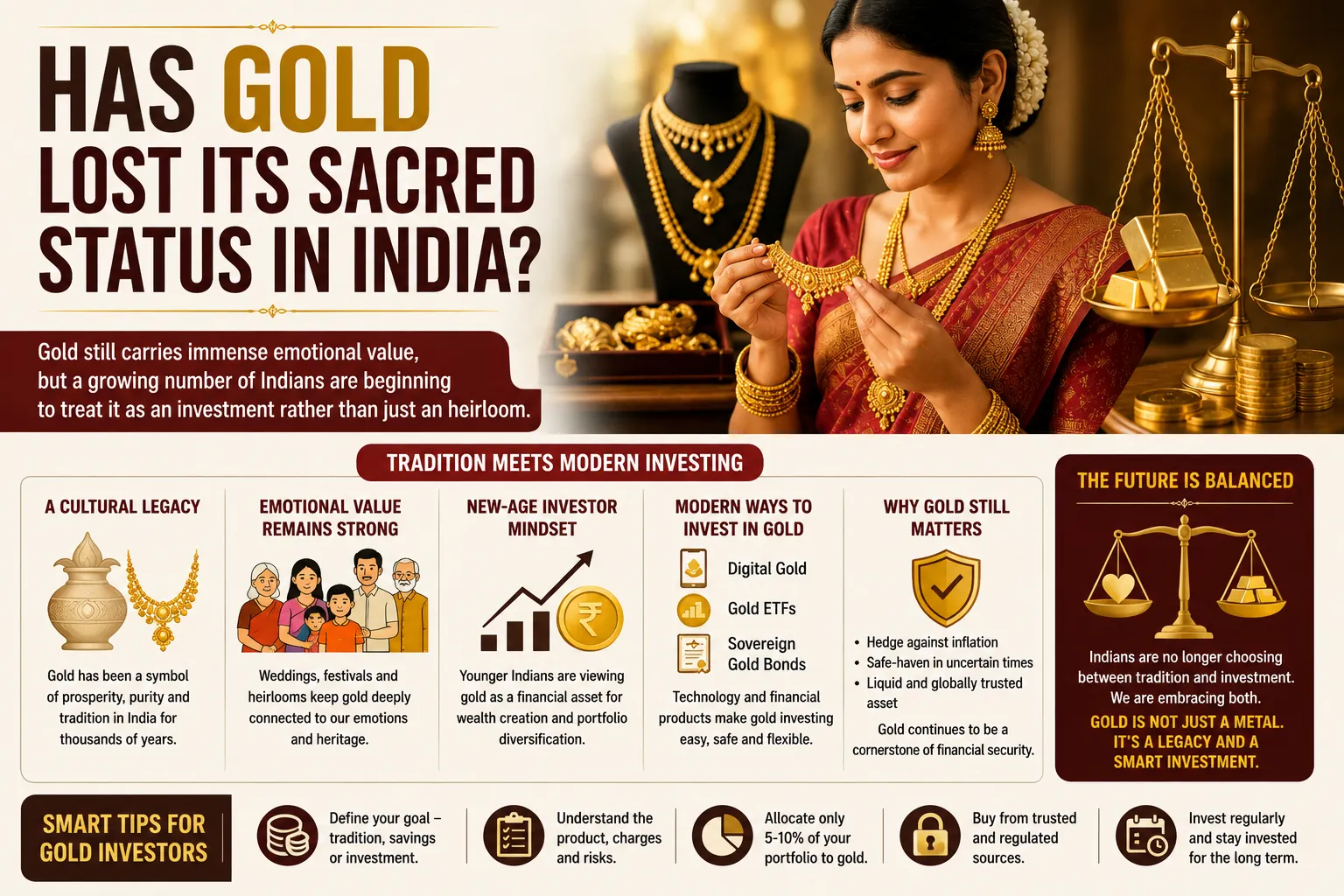
For centuries, gold has occupied a unique place in Indian society. It is more than a precious metal—it symbolizes prosperity, security, status, and tradition. From weddings and festivals to religious ceremonies and family inheritance, gold has been deeply woven into India’s cultural and economic fabric. Owning gold has long been regarded as a sign of financial stability, while gifting it has represented blessings, wealth, and goodwill.
However, the way Indians perceive gold is gradually changing. While its emotional and cultural significance remains strong, an increasing number of investors are beginning to view gold through a financial lens rather than solely as a family heirloom. Younger generations are embracing digital investment platforms, exchange-traded funds, sovereign gold bonds, and systematic investment strategies, transforming gold from a traditional asset into a modern investment instrument.
This shift does not necessarily mean that gold has lost its sacred status. Instead, it reflects the evolving relationship between tradition and financial planning in an increasingly digital and economically aware society.
Gold’s Deep Cultural Roots in India
India has one of the world’s oldest traditions of gold ownership.
For generations, families have purchased gold during festivals such as Dhanteras, Akshaya Tritiya, and Diwali, believing it symbolizes prosperity and good fortune. Gold jewellery has also played a central role in weddings, where it often represents family wealth, security, and cultural heritage.
In many households, gold is passed down from one generation to another, carrying emotional memories that extend far beyond its market value.
Unlike many financial assets, gold has traditionally represented both economic security and cultural identity.
This emotional attachment continues to distinguish gold from most other forms of investment.
Why Indians Have Always Trusted Gold
One reason for gold’s enduring popularity is its historical reliability.
Unlike paper currency, gold has retained value across generations despite inflation, economic uncertainty, and changing political conditions.
During periods of financial instability, investors around the world often consider gold a “safe-haven” asset because it tends to preserve purchasing power over the long term.
For Indian families, this reputation has strengthened trust in gold as a dependable store of wealth.
Even households with limited financial knowledge have traditionally viewed gold as a practical savings instrument.
A New Generation Is Thinking Differently
While emotional attachment remains strong, younger Indians are approaching gold differently.
Millennials and Generation Z have grown up with access to online banking, stock markets, mutual funds, cryptocurrencies, digital payments, and financial education through the internet.
Rather than purchasing jewellery alone, many now invest in gold through financial products designed specifically for investors.
Digital gold platforms, gold exchange-traded funds (ETFs), and sovereign gold bonds have made investing in gold easier without requiring physical storage.
For many young investors, gold has become part of a diversified investment portfolio rather than solely a cultural possession.
Jewellery Versus Investment
Traditionally, most Indian households accumulated wealth through gold jewellery.
However, jewellery involves additional costs such as making charges, design premiums, and taxes, which may reduce investment returns if sold later.
Modern investors increasingly distinguish between purchasing jewellery for personal use and investing in gold for financial purposes.
Financial products linked to gold prices allow investors to benefit from price movements without incurring jewellery-related costs.
This distinction reflects growing financial awareness among Indian consumers.
The Rise of Digital Gold
Technology has significantly changed how people invest in precious metals.
Digital gold allows individuals to purchase small quantities online using smartphones or digital payment platforms.
Investors can begin with modest amounts rather than waiting until they can afford large jewellery purchases.
The convenience of digital transactions has made gold investing more accessible, especially for young professionals living in urban areas.
Although investors should understand the regulatory framework governing different investment products, digital platforms have undoubtedly expanded participation in gold investing.
Sovereign Gold Bonds and Gold ETFs
Government-backed Sovereign Gold Bonds (SGBs) and Gold Exchange-Traded Funds (ETFs) have also contributed to changing investor behaviour.
Sovereign Gold Bonds offer returns linked to gold prices while also providing periodic interest payments during their tenure.
Gold ETFs enable investors to gain exposure to gold prices through stock exchanges without physically owning the metal.
These financial products have encouraged investors to think of gold as part of long-term wealth creation rather than only ceremonial ownership.
Financial planners increasingly recommend allocating a limited percentage of investment portfolios to gold for diversification.
Rising Gold Prices Have Changed Buying Patterns
Gold prices have witnessed significant appreciation over recent years.
Higher prices have affected purchasing behaviour, particularly among middle-income families.
Instead of buying large quantities of jewellery, many consumers now purchase lighter designs or invest smaller amounts periodically.
Some families continue traditional purchases during festivals but supplement them with financial investments linked to gold prices.
This gradual shift demonstrates changing priorities without eliminating cultural traditions.
Gold Still Plays a Major Role in Weddings
Despite changing investment habits, weddings remain one of the largest sources of gold demand in India.
Gold jewellery continues to symbolize prosperity, family prestige, and blessings for newly married couples.
Many families consider gifting gold an important cultural tradition that reflects affection and financial support.
Although younger couples may prefer simpler designs or lighter jewellery, the custom itself remains deeply rooted.
The emotional significance attached to wedding jewellery continues to preserve gold’s cultural importance.
Women and Financial Independence
Gold ownership has historically provided financial security for many Indian women.
Jewellery often represented personal assets that could be used during emergencies or difficult financial situations.
Today, women are increasingly participating directly in financial planning and investment decisions.
Many now combine traditional jewellery ownership with investments in gold funds, bonds, and other financial products.
This evolution reflects broader changes in women’s economic participation and financial literacy.
Is Gold Still a Safe Investment?
Financial experts generally regard gold as an important diversification tool rather than a standalone investment strategy.
Gold often performs differently from equities and other financial assets, making it useful for balancing investment portfolios during periods of economic uncertainty.
However, experts also caution that gold prices fluctuate and should be considered within the context of an individual’s financial goals, investment horizon, and risk tolerance.
Most advisors recommend maintaining balanced portfolios rather than concentrating investments exclusively in one asset class.
The Emotional Value Has Not Disappeared
Although investment behaviour is evolving, gold’s emotional significance remains remarkably strong.
Families continue purchasing gold during important life events, celebrating festivals with traditional gold purchases, and preserving heirloom jewellery across generations.
Many people still associate gold with prosperity, security, and family heritage.
Rather than replacing these traditions, financial investing has simply added another dimension to gold ownership.
For many Indians today, gold simultaneously represents emotion and economics.
The Future of Gold in India
The future of gold in India is likely to reflect both continuity and change.
Traditional jewellery demand is expected to remain strong because of cultural customs and religious practices.
At the same time, financial investment in gold will probably continue expanding as digital platforms, financial literacy, and investment awareness increase.
Technology may further simplify access through mobile investing, fractional ownership, and integrated financial planning tools.
As younger generations become financially sophisticated, gold’s role may continue evolving from exclusive cultural symbolism toward a balanced combination of tradition and investment.
Conclusion
Gold has not lost its sacred status in India—it has simply gained a new identity. While its cultural importance remains deeply embedded in festivals, weddings, family traditions, and emotional memories, modern investors increasingly recognize its financial value as part of diversified wealth management.
Today’s Indians are no longer choosing between tradition and investment. Instead, they are embracing both. Families continue to cherish inherited jewellery while younger investors explore digital gold, sovereign gold bonds, and exchange-traded funds to achieve long-term financial goals. This transformation reflects a broader evolution in financial thinking rather than a decline in cultural values.
Ultimately, gold remains one of India’s most trusted assets because it successfully bridges the past and the future. It continues to symbolize prosperity and heritage while adapting to the changing needs of a modern economy, proving that its significance extends far beyond sentiment alone.