Not Just a Target: How Manusmriti Can Also Be a Rhetorical Weapon
The Manusmriti, an ancient Sanskrit text on dharma, law and social conduct, has returned to the centre of public debate in India. Recent political references to specific verses, particularly those concerning women, have renewed calls to reject the text as a symbol of patriarchy and hierarchy. Yet a closer look at the work itself reveals a more complicated picture. While certain passages are difficult to defend by contemporary standards of equality, the text also contains ideas that can be turned against selective or simplistic modern appropriations of “Hindu tradition.” In that sense, Manusmriti is not only a target; it can also function as a rhetorical weapon.
The Immediate Political Context
In a recent public interaction with students, a prominent political leader quoted Manusmriti 9.3, which describes a woman as dependent on her father in childhood, her husband in youth and her sons in old age, and stated that she should not live independently. The verse was presented as evidence of deep-rooted patriarchal thinking, and the audience was urged to challenge such ideas. The quotation landed powerfully because the language is unambiguous by modern measures of gender equality. Few defenders of tradition can uphold that specific formulation without appearing to endorse subordination.
The critique is factually grounded in the text. The difficulty lies in treating any single verse, or even a cluster of verses, as the complete statement of a complex and internally varied document. Manusmriti is not a uniform code. Scholars note that it contains contradictions, layers of composition, and passages that pull in different directions. Reducing it to one set of verses simplifies both the historical document and the contemporary argument.
Understanding ‘Sattvik’ Beyond Popular Usage
One illustration of the gap between popular understanding and the text’s own framework appears in the concept of sattvik. In everyday Indian discourse, sattvik is frequently associated with food—vegetarian items considered pure, light and conducive to calmness. In the psychological and metaphysical scheme reflected in Manusmriti and related literature, the term operates differently.
Sattva is one of the three gunas or fundamental qualities. In this system, sattvik characteristics include austerity, pursuit of knowledge and wisdom, purity, control of the senses, and diligent performance of one’s duties. These qualities are linked to mental disposition and, within the text’s worldview, to the nature of future births. The emphasis is on inner discipline, intellectual and moral refinement, and self-restraint rather than on dietary categories alone. Food may be discussed elsewhere in the tradition as an influence on the mind, but the core meaning of sattvik in this context is psychological and ethical.
This distinction matters. When contemporary discussions reduce traditional categories to lifestyle preferences or identity markers, they often detach them from the original conceptual framework. Returning to the text’s own terms can expose inconsistencies in how “tradition” is selectively invoked today.
A Text of Internal Tensions
Manusmriti addresses a wide range of subjects: the duties of different social groups, rules for kings, principles of justice, personal conduct, and the consequences of actions across lifetimes. Large portions focus on the conduct expected of Brahmins and Kshatriyas. It contains hierarchical prescriptions that later reformers, most notably B.R. Ambedkar, subjected to sustained and influential critique. At the same time, the text also elaborates ideals of self-control, learning, non-injury in certain contexts, and the primacy of knowledge and austerity in spiritual progress.
These internal tensions mean that the same document can be mined for opposing purposes. Critics highlight verses that institutionalise inequality. Others point to passages that elevate learning, restraint and duty as universal goods. Both approaches involve selection. The text does not speak with a single modern voice; readers supply the framing.
Weaponisation Works in More Than One Direction
The argument that Manusmriti can serve as a weapon rests on this selectivity. Those who attack the text often isolate its most hierarchical or patriarchal statements. Those who defend a romanticised version of tradition sometimes ignore those same statements or relativise them out of existence. A more rigorous engagement would use the text’s own stated values—such as the primacy of knowledge, austerity and self-mastery—to question contemporary claims that invoke “dharma” while displaying little of those qualities.
If sattvik is understood as disciplined pursuit of wisdom and control of the senses, then public conduct that prioritises power, grievance or spectacle over knowledge and restraint becomes open to critique on traditional grounds. In this way, the text can be turned against some of its most vocal modern champions as well as against its most vocal modern critics. The weapon cuts more than one way.
Historical Perspective and Contemporary Stakes
Scholars generally date the core of Manusmriti between the second century BCE and the second century CE, with later additions and variations across manuscripts. It was never a uniformly enforced legal code across the subcontinent; its influence was real but uneven, mediated by local custom, royal authority and evolving interpretation. Treating it as either the essence of Hinduism or as a simple manual of oppression flattens a more intricate historical record.
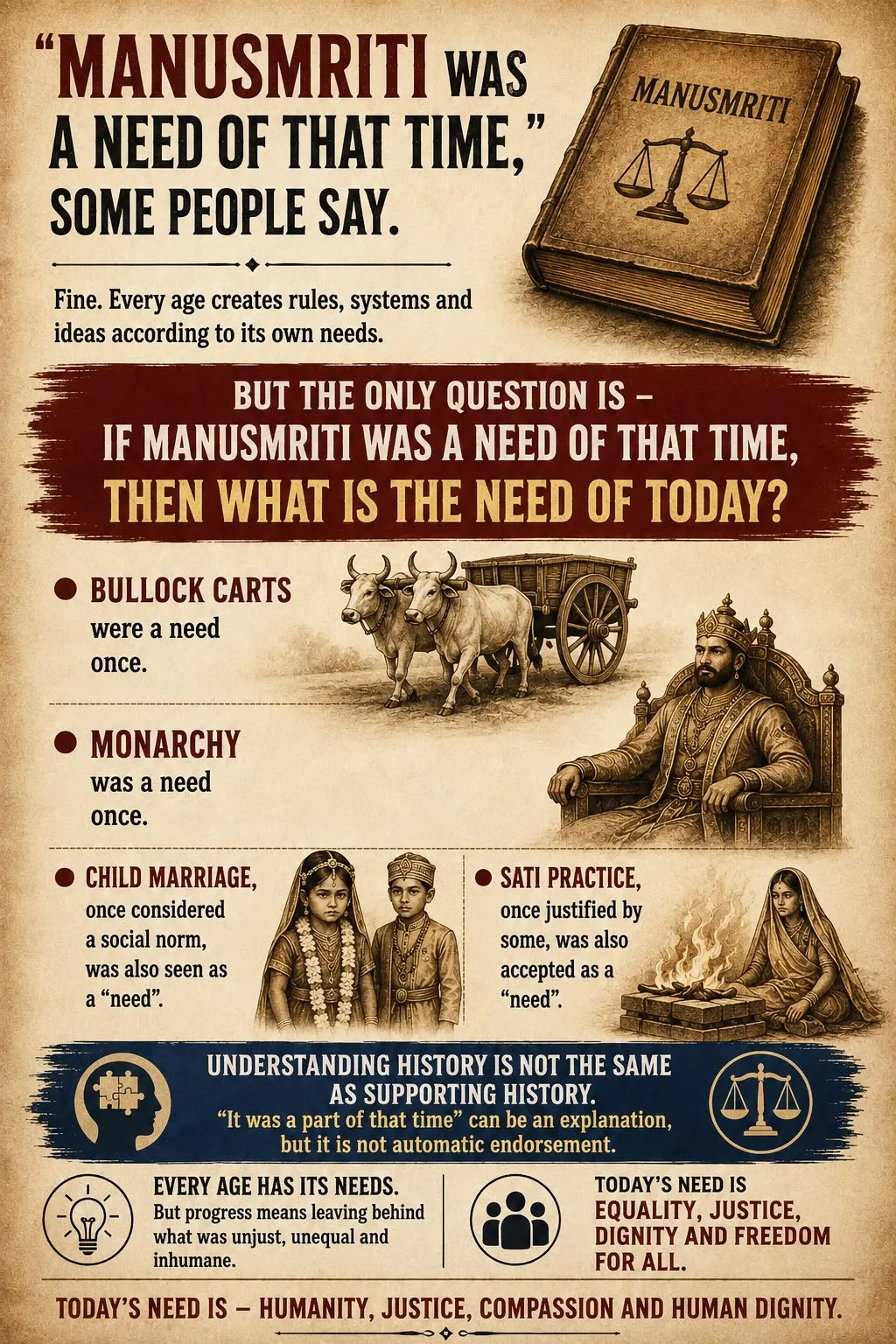
In today’s politics, the text functions less as a living legal authority and more as a symbol. For some, it represents the persistence of hierarchical thinking that constitutional values were meant to overcome. For others, attacks on it represent an attack on civilisational continuity. Both positions can harden into dogma. A more productive approach would acknowledge the problematic passages without denying the text’s complexity, and would test contemporary claims against the ethical standards the text itself articulates in its higher registers.
Beyond Simple Targets
The recent controversy shows how ancient texts remain available for modern rhetorical use. Quoting Manusmriti 9.3 effectively highlights patriarchal language that many find unacceptable. Yet stopping there leaves unexamined the broader architecture of the work, including its discussion of qualities that lead to wisdom and better rebirth. Engaging those elements does not require defending inequality. It requires reading with enough care to notice when modern invocations of tradition fail the very standards they claim to uphold.
Manusmriti will continue to be a target because parts of it conflict with contemporary commitments to equality and individual autonomy. It can also be a weapon—against selective nostalgia, against the reduction of complex categories like sattvik to lifestyle branding, and against any politics that claims the authority of tradition while neglecting the disciplines of knowledge, restraint and duty that the text places at the centre of a higher life. The more carefully the document is read, the harder it becomes to use it as a one-sided slogan. That difficulty may be its most useful contribution to the present debate.
Read more – SmallBizSeo.org