Why Young Indians Are Risking Fines and Arrest to Explore Abandoned Places
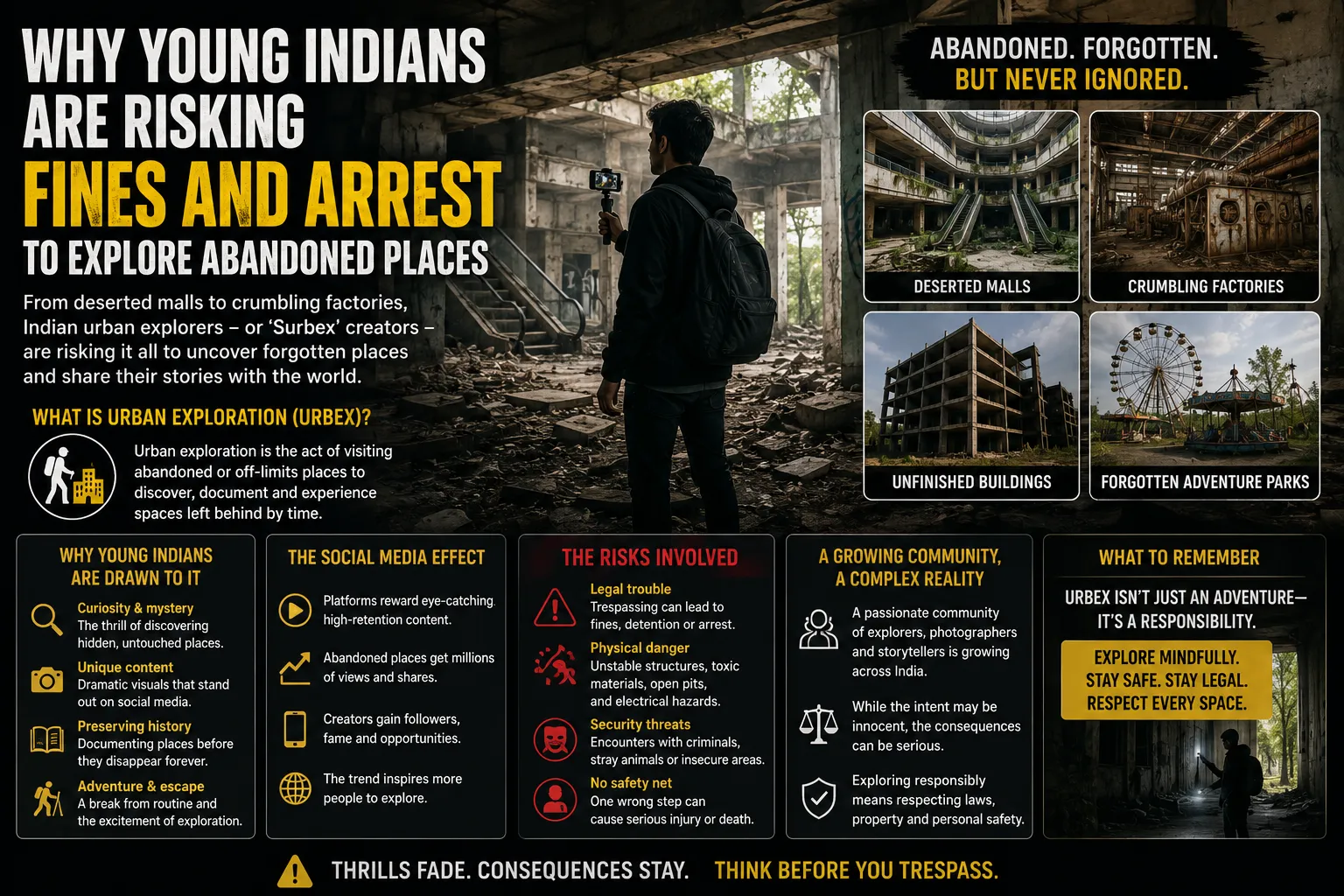
A deserted shopping mall with broken escalators. An abandoned amusement park slowly being reclaimed by nature. A crumbling factory frozen in time. A half-finished skyscraper standing silently against the skyline.
These are not scenes from a movie set. They are real locations scattered across India, and they have become the focus of a rapidly growing online trend known as urban exploration, or “urbex.”
Across Instagram, YouTube, and other social media platforms, a new generation of Indian content creators is venturing into abandoned and off-limits spaces to document forgotten corners of the country’s urban landscape. Their videos often attract millions of views, showcasing eerie architecture, hidden rooms, decaying infrastructure, and places that seem untouched by time.
But behind the dramatic visuals lies a controversial hobby that frequently involves significant risks. From legal consequences and safety hazards to ethical concerns, urban exploration raises important questions about why so many young people are willing to risk fines, injury, or even arrest for the chance to explore abandoned places.
The Rise of Urban Exploration in India
Urban exploration is not a new phenomenon.
The activity has existed for decades in different parts of the world, where enthusiasts explore abandoned buildings, underground tunnels, industrial sites, and forgotten infrastructure. Traditionally, urban explorers documented these spaces through photography and personal storytelling.
However, social media has transformed what was once a niche hobby into a mainstream cultural trend.
In India, urban exploration content has expanded rapidly over the past few years. Young creators regularly share videos featuring abandoned malls, closed factories, unfinished residential projects, deserted hotels, forgotten cinemas, and neglected amusement parks.
The visual appeal of these locations makes them highly attractive for online audiences. Empty hallways, broken furniture, rusting machinery, and overgrown vegetation create an atmosphere that is both mysterious and cinematic.
As a result, exploration videos often perform exceptionally well on social media platforms.
The Power of Social Media
One of the biggest drivers behind the trend is the influence of digital content platforms.
Social media algorithms reward content that captures attention quickly. Abandoned places naturally create curiosity because they present environments that most people rarely see.
Viewers are often fascinated by questions such as:
- Why was this place abandoned?
- What happened here?
- Who used to visit this location?
- What secrets remain inside?
These questions encourage engagement, shares, comments, and repeat viewing.
For content creators, abandoned locations provide unique visuals that stand out from ordinary travel or lifestyle content. In an increasingly crowded digital environment, originality is valuable.
The result is a growing ecosystem of creators competing to discover more unusual, dramatic, and visually striking locations.
The Appeal of the Unknown
At its core, urban exploration is driven by curiosity.
Human beings are naturally attracted to mystery and discovery. Abandoned places offer an opportunity to step into environments that have been forgotten, neglected, or left behind.
Unlike tourist attractions, these spaces are often undocumented and unpredictable.
Every abandoned building tells a story.
A deserted school may reveal old textbooks scattered across classrooms. An abandoned factory may contain machinery that has not moved in decades. A forgotten amusement park may still display faded signs and rusting rides.
For many explorers, the excitement comes from uncovering these hidden stories and preserving them through photographs and videos.
The experience creates a sense of discovery that is increasingly rare in a world where most locations can be viewed online before visiting them.
Adventure in an Urban World
Modern cities are becoming increasingly structured and predictable.
Shopping centers, office buildings, transportation systems, and residential complexes are carefully designed and monitored. Many young people spend much of their daily lives navigating highly regulated environments.
Urban exploration offers a stark contrast.
It introduces uncertainty, challenge, and adventure into otherwise familiar urban landscapes.
Explorers often describe the experience as a real-world treasure hunt. Finding a hidden location may require extensive research, long walks, navigation through unfamiliar neighborhoods, and problem-solving skills.
The challenge itself becomes part of the attraction.
For some participants, the activity satisfies a desire for adventure that traditional urban life may not provide.
Preserving Forgotten History
Not all urban explorers are motivated purely by excitement.
Many view their work as a form of historical documentation.
India’s rapid urban development means that old structures are frequently demolished, renovated, or replaced. As cities expand, industrial sites, colonial-era buildings, theaters, and public infrastructure often disappear from the landscape.
By photographing and documenting abandoned places, some explorers believe they are preserving important pieces of urban history.
These locations can provide valuable insights into architectural styles, industrial development, economic shifts, and cultural change.
In some cases, the images captured by urban explorers become the last visual records of structures that are later demolished.
This documentary aspect has helped urban exploration gain legitimacy among certain photographers, historians, and architecture enthusiasts.
The Risks Behind the Trend
Despite its appeal, urban exploration is far from harmless.
Many abandoned buildings are structurally unstable.
Floors may collapse without warning. Staircases can be damaged or unsafe. Roofs may be weakened by years of neglect.
In addition to physical hazards, explorers often face environmental risks such as exposed electrical wiring, toxic materials, broken glass, and hazardous debris.
Some abandoned sites may also attract criminal activity, illegal dumping, or unauthorized occupants.
The danger increases significantly when individuals enter locations without proper preparation or safety equipment.
Unfortunately, social media videos do not always show the full extent of these risks.
Legal Consequences
Another major concern involves legality.
Many abandoned properties remain privately owned even when they appear deserted.
Entering such locations without permission can constitute trespassing and may lead to fines, detention, or arrest depending on local laws and circumstances.
Security personnel frequently patrol certain sites, particularly unfinished commercial developments, industrial facilities, and transportation infrastructure.
Authorities often view unauthorized entry as a security issue rather than a recreational activity.
As urban exploration grows in popularity, law enforcement agencies and property owners may increase monitoring efforts to discourage unauthorized access.
Young content creators seeking dramatic footage sometimes underestimate the potential legal consequences of their actions.
Why the Trend Continues to Grow
Despite the risks, interest in urban exploration continues to expand.
Part of the reason lies in broader cultural shifts among younger generations.
Many young people are increasingly interested in authentic experiences rather than conventional forms of entertainment. They seek unique stories, unusual locations, and opportunities to stand out in a highly connected digital world.
Abandoned places offer all three.
They combine mystery, history, adventure, photography, and storytelling in a way that few other activities can match.
The popularity of “liminal spaces”—locations that feel suspended between past and present—has further amplified interest in forgotten buildings and deserted environments.
These spaces evoke nostalgia, curiosity, and reflection, making them especially appealing to digital audiences.
The Future of Urban Exploration in India
As India’s cities continue to evolve, abandoned spaces will likely remain a source of fascination.
The growing number of ghost malls, unfinished developments, industrial relics, and aging infrastructure ensures that urban explorers will continue discovering new locations to document.
However, the future of the trend may depend on balancing curiosity with responsibility.
Safety awareness, respect for private property, historical preservation, and ethical content creation will become increasingly important as more people enter the community.
Responsible exploration can contribute to documenting urban history and raising awareness about neglected spaces. Irresponsible exploration, however, can lead to accidents, legal problems, and damage to historic sites.
Conclusion
The rise of urban exploration among young Indians reflects more than a fascination with abandoned buildings. It reveals a broader desire for discovery, adventure, storytelling, and connection with forgotten aspects of the urban environment.
Social media has transformed deserted malls, abandoned factories, and unfinished structures into powerful symbols of mystery and curiosity. While the dramatic footage attracts millions of viewers, the reality behind the trend involves significant risks that cannot be ignored.
As urban exploration continues to grow, its long-term impact will depend on how participants balance excitement with responsibility. For many young explorers, the appeal lies not merely in entering abandoned places but in uncovering the stories hidden within them—stories that might otherwise be lost to time.