Can ₹30,000 Truly Measure a Homemaker’s Labour? Women Weigh In on the Supreme Court Ruling
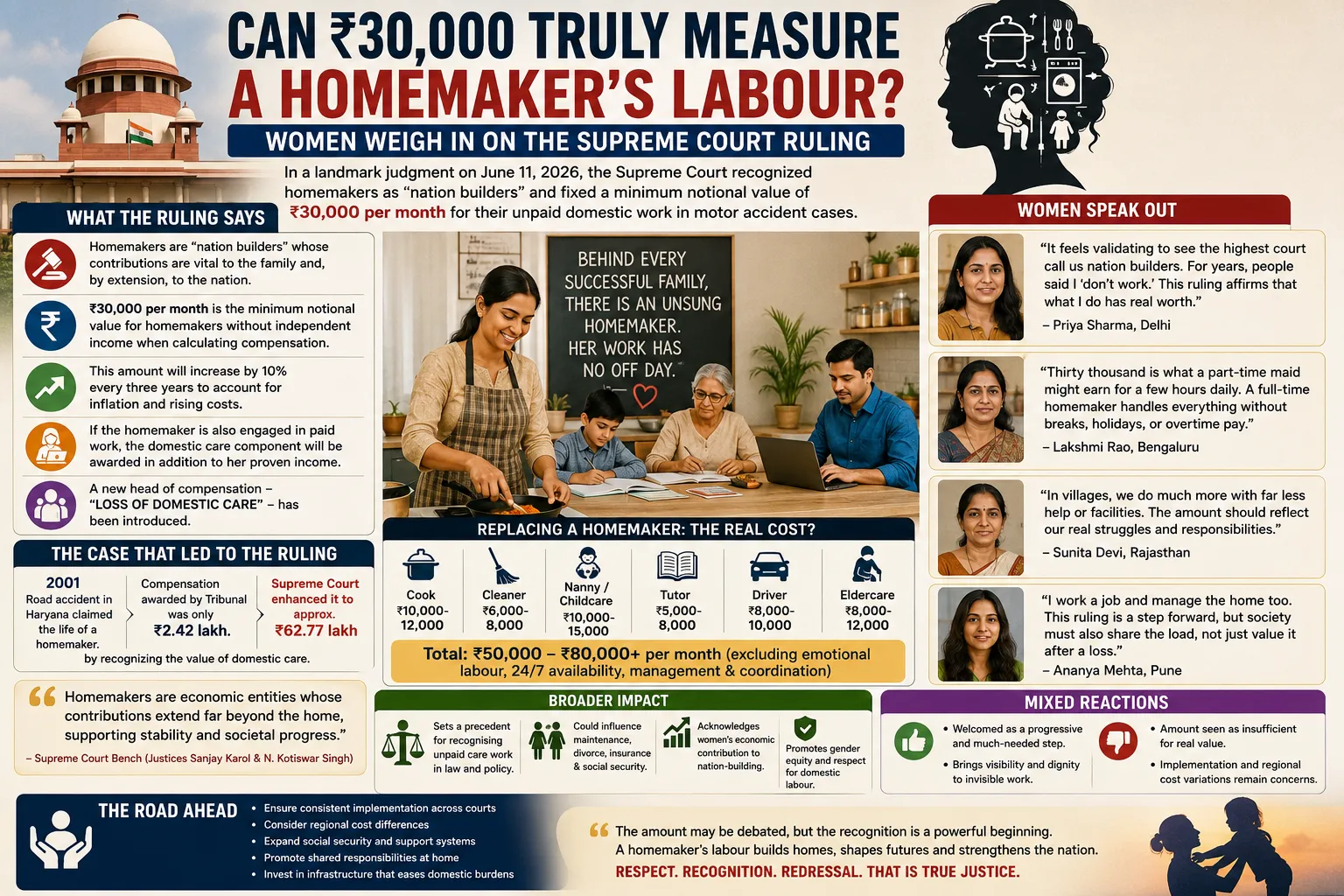
In a landmark judgment delivered on June 11, 2026, the Supreme Court of India recognized homemakers as “nation builders” and established a minimum notional monthly value of ₹30,000 for their unpaid domestic work when calculating compensation in motor accident cases. The ruling introduces a new head of compensation termed “loss of domestic care,” addressing long-standing gaps in how courts have valued the invisible contributions of millions of women who manage households without formal salaries. While the decision marks a significant step toward acknowledging unpaid labour, many homemakers argue that the figure falls short of reflecting the true scope and intensity of their daily responsibilities.
The case originated from a 2001 road accident in Haryana that claimed the life of a homemaker. Initial compensation awarded by the Motor Accidents Claims Tribunal stood at a modest ₹2.42 lakh. Through successive appeals, the Supreme Court enhanced it substantially to approximately ₹62.77 lakh, incorporating the new framework for valuing domestic care. The bench comprising Justices Sanjay Karol and N. Kotiswar Singh emphasized that homemakers are economic entities whose contributions extend far beyond the home, supporting family stability and, by extension, societal progress.
Understanding the Ruling: A New Framework for Justice
The judgment clarifies that ₹30,000 per month serves as a baseline “stand-in” income for homemakers without independent earnings. This amount is to be used for calculating loss of dependency and future prospects, with a mandated 10% increase every three years to account for inflation and rising living costs. Importantly, when a homemaker also participates in paid work, the domestic care component is awarded in addition to her proven income.
Courts have historically struggled with quantifying non-monetary contributions, often assigning arbitrary low notional incomes that undervalued women’s roles. By creating a distinct “loss of domestic care” head, the Supreme Court acknowledges multifaceted duties: cooking, cleaning, childcare, eldercare, financial management within the household, emotional support, and coordination of family needs. These tasks enable other family members to pursue education and employment, generating broader economic value.
Legal experts view this as a progressive shift that could influence other areas of law, including maintenance claims, divorce proceedings, and insurance policies, by setting a precedent for recognizing unpaid care work.
Homemakers’ Perspectives: Acknowledgment vs. Adequacy
Women across India have responded with a mix of appreciation and critique. Many welcome the judicial recognition after decades of their labour being dismissed as non-productive. “It feels validating to see the highest court call us nation builders,” shares Priya Sharma, a homemaker from Delhi raising two children and caring for in-laws. “For years, people said I ‘don’t work.’ This ruling affirms that what I do has real worth.”
However, the ₹30,000 figure sparks widespread debate. Homemakers point out that replacing their roles would require hiring multiple professionals—a cook, cleaner, nanny, tutor, driver, and eldercare attendant—whose combined salaries could easily exceed ₹50,000–80,000 monthly in urban areas, excluding the intangible emotional labour and 24/7 availability. “Thirty thousand is what a part-time maid might earn for a few hours daily,” notes Lakshmi Rao from Bengaluru. “A full-time homemaker handles everything without breaks, holidays, or overtime pay.”
Rural women and those from lower-income families often shoulder even heavier burdens with limited access to appliances or help, making the standardized amount seem particularly insufficient. Working women who balance jobs and homes feel the ruling partially addresses the “double shift” phenomenon but stops short of broader societal reforms like better childcare support or shared domestic responsibilities.
Broader Implications for Gender and Economic Equity
The ruling arrives amid growing global conversations on unpaid care work. According to various economic analyses, women perform the vast majority of such labour worldwide, contributing trillions in invisible economic output. In India, where female labour force participation remains low, recognizing homemakers’ roles could encourage more women to enter paid employment by reducing the penalty of career breaks for family care.
Advocates argue this decision challenges patriarchal norms that undervalue women’s contributions. It sends a message that domestic labour is skilled, essential work deserving economic dignity. Some suggest it could influence corporate policies on parental leave, flexible work, and gender budgeting in government schemes.
Challenges remain. Implementation will depend on Motor Accidents Claims Tribunals consistently applying the new guidelines. Socio-economic disparities mean the flat rate may not capture regional cost variations or individual circumstances. Critics also note that while compensation for loss is addressed, preventive measures—like road safety and support systems for families—require equal attention.
Voices from the Ground: Mixed Reactions and Calls for More
Social media and public discourse reveal polarized views. While many celebrate the progressive stance, some men have reacted defensively, questioning “who will pay” or making derogatory remarks about multiple partners or renegotiating terms—highlighting persistent societal resistance to valuing women’s work. Homemakers counter that the ruling is not about demanding salaries from husbands but ensuring fair redressal in tragedy.
Sushma Gupta, a homemaker and activist from Mumbai, sums up the sentiment: “The amount is a starting point, not the ceiling. It’s about dignity and visibility. We need this recognition to translate into respect within families and policies that support women’s choices—whether staying home or working outside.”
Younger women express hope that the judgment will influence future generations, normalizing the idea that care work has monetary and social value. Some call for complementary steps, such as including homemakers in social security nets, pension schemes, or skill development programs that acknowledge their expertise in household management.
A Step Forward, With Room to Grow
The Supreme Court’s decision represents a judicial evolution in understanding gender, labour, and justice. By quantifying a minimum value and framing homemakers as foundational to national progress, it elevates a conversation long confined to feminist circles into mainstream legal doctrine. Yet, as women themselves emphasize, no single figure can fully encapsulate the physical, mental, and emotional investment of homemaking.
True progress lies in moving beyond compensation for loss toward prevention of devaluation in everyday life. This includes promoting shared responsibilities at home, investing in infrastructure that eases domestic burdens, and fostering cultural shifts that celebrate diverse roles for women. The ₹30,000 benchmark is a powerful acknowledgment—but the real measure of a homemaker’s labour ultimately lies in the stability, love, and opportunity she creates for her family and society every single day.
As India grapples with gender equity goals, this ruling offers both validation and a call to action. It reminds us that economic models ignoring unpaid care work are incomplete, and that recognizing women’s full contributions is essential for holistic national development. Homemakers may debate the exact number, but few disagree on the importance of the recognition itself.