Can India Balance the Right to Walk and the Right to Earn? Understanding the Supreme Court’s Landmark Footpath Ruling
Supreme Court’s Landmark Judgment Sparks a Debate on Footpaths, Street Vendors, and Urban Rights
India’s footpaths have long served multiple purposes. They are meant to provide pedestrians with safe passage, but in reality they often function as marketplaces, parking zones, storage spaces, construction sites, or extensions of nearby shops. This everyday reality has created a constant conflict between two equally important needs—the public’s right to walk safely and the livelihood of millions of street vendors.
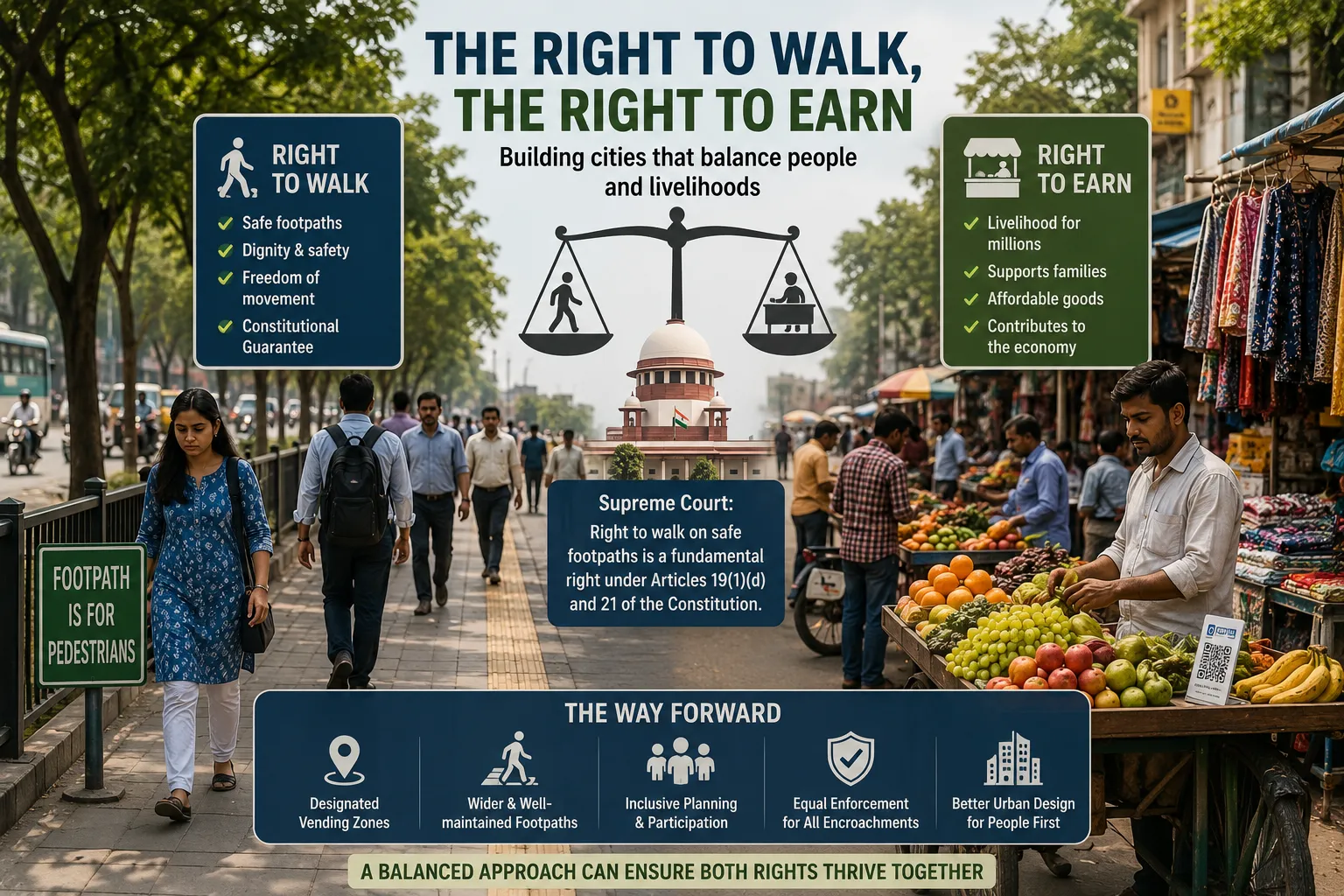
The debate has gained fresh momentum after the Supreme Court declared that the right to walk on safe, demarcated footpaths is a fundamental right protected under Articles 19(1)(d) and 21 of the Constitution. The ruling places a constitutional obligation on governments and local bodies to construct, maintain, and protect pedestrian infrastructure.
However, the judgment also raises an important social question: Can India ensure safe footpaths without depriving street vendors of their primary source of income? Finding an answer requires balancing constitutional rights with economic realities rather than treating one as more important than the other.
What Did the Supreme Court Say?
The Supreme Court delivered its landmark ruling while hearing a motor accident compensation case involving the tragic death of a five-year-old child who was walking along a road without a proper footpath. The Court observed that if roads exist, authorities also have a corresponding duty to provide safe and clearly demarcated footpaths for pedestrians.
The Bench held that:
- The right to walk safely forms part of the constitutional guarantee of freedom of movement under Article 19(1)(d).
- It is also connected to the right to life under Article 21.
- Pedestrian rights should receive priority over motorised traffic on designated footpaths.
- Urban development authorities, municipal corporations, municipalities and panchayats have a legal responsibility to construct, maintain and safeguard pedestrian infrastructure.
- The Court also recommended creating an independent regulatory framework to ensure accountability and effective implementation.
The judgment significantly shifts the focus from merely building roads for vehicles to creating cities that are equally safe for people walking.
Why Safe Footpaths Matter
Walking remains India’s most common mode of transport. Millions of people walk daily to schools, workplaces, railway stations, markets, hospitals and bus stops. Even those who own vehicles become pedestrians after parking.
Despite this, pedestrian infrastructure remains one of the weakest aspects of urban planning.
Many Indian cities suffer from:
- Missing or broken pavements.
- Encroachments by parked vehicles.
- Construction debris.
- Utility poles and transformers placed on walkways.
- Illegal extensions of commercial establishments.
- Vendors occupying the entire pedestrian path.
As a result, pedestrians are frequently forced onto busy roads, increasing the risk of accidents. Road safety experts have repeatedly highlighted that vulnerable road users—including pedestrians, cyclists and children—face the greatest danger because urban infrastructure prioritizes motor vehicles over people.
The Supreme Court’s ruling acknowledges that safe walking is not merely a convenience but a basic constitutional entitlement.
The Other Side of the Story: India’s Street Vendors
While reclaiming footpaths sounds straightforward, the issue becomes more complex when considering India’s street vendors.
Street vending supports millions of families across the country. Vendors sell vegetables, fruits, snacks, clothes, books, flowers and countless everyday essentials at affordable prices. They also provide convenient services close to residential neighbourhoods and public transport hubs.
For many vendors, footpaths represent the only affordable place to conduct business. Renting commercial shops is financially impossible for small entrepreneurs operating with limited capital.
Street vending also contributes significantly to India’s informal economy by:
- Creating self-employment.
- Supporting migrant workers.
- Offering affordable goods to consumers.
- Strengthening local supply chains.
- Reducing unemployment.
Therefore, treating every vendor simply as an illegal encroacher ignores the economic role they play in urban life.
The Street Vendors Act Already Offers a Framework
India is not without legal protections for vendors.
The Street Vendors (Protection of Livelihood and Regulation of Street Vending) Act, 2014 was enacted to recognize street vending as a legitimate economic activity while regulating public spaces.
The law provides for:
- Town Vending Committees.
- Surveys of street vendors.
- Identification of vending zones.
- Protection against arbitrary eviction.
- Transparent relocation procedures.
- Participatory urban planning involving vendors.
The objective was never to eliminate street vending but to regulate it in a manner that protects both livelihoods and public convenience.
Unfortunately, implementation has been uneven across states. Many cities have delayed surveys, failed to establish vending zones or carried out eviction drives without fully following legal procedures.
The Real Problem Is Poor Urban Planning
The conflict between pedestrians and vendors often reflects a larger planning failure.
Cities frequently lack:
- Wide pavements.
- Dedicated vending areas.
- Proper parking facilities.
- Organized public markets.
- Effective enforcement against illegal parking.
As a result, everyone competes for the same limited public space.
In many locations, illegally parked vehicles occupy more pedestrian space than vendors. Construction material, utility infrastructure and unauthorized commercial extensions further shrink available walking areas.
Simply removing vendors without addressing these broader issues would solve only part of the problem.
Can Both Rights Coexist?
The answer is yes—but only through thoughtful planning.
Many cities around the world have demonstrated that street vending and pedestrian movement can successfully coexist through proper design.
Possible solutions include:
Clearly Marked Vending Zones
Instead of allowing random occupation, authorities can designate specific vending areas that leave sufficient walking space.
Wider Footpaths
Modern urban planning can incorporate wider pavements capable of accommodating both pedestrians and regulated vending.
Time-Based Vending
Certain commercial areas may permit vending during specified hours while ensuring free movement during peak traffic periods.
Strict Action Against All Encroachments
Enforcement should apply equally to illegally parked vehicles, permanent commercial extensions, construction debris and unauthorized occupations—not just vendors.
Better Urban Design
Future road projects should integrate pedestrian infrastructure from the planning stage rather than treating footpaths as an afterthought.
Accountability Will Determine Success
One of the most significant aspects of the Supreme Court’s judgment is its emphasis on institutional responsibility.
For years, citizens have accepted missing footpaths as an unavoidable feature of Indian cities. The ruling changes this perspective by recognizing that providing safe pedestrian infrastructure is a legal obligation, not merely an administrative choice.
However, experts have pointed out that legal recognition alone will not transform Indian streets unless accountability mechanisms are established. Municipal authorities must be held responsible for maintaining footpaths, preventing encroachments and ensuring compliance with planning standards.
Without effective enforcement, even landmark judgments risk remaining only on paper.
Building Cities for Everyone
The debate should not become a choice between pedestrians and vendors.
Both represent ordinary citizens exercising legitimate rights.
Pedestrians deserve safe, obstruction-free footpaths that protect their lives and dignity.
Street vendors deserve predictable policies that safeguard their livelihoods and prevent arbitrary displacement.
The real challenge lies in redesigning Indian cities so that neither group is forced into conflict with the other.
Future urban development must prioritize inclusive planning where roads are designed not only for cars but also for people who walk, cycle, work and earn their living in public spaces.
Conclusion
The Supreme Court’s recognition of the right to walk as a fundamental right marks an important milestone in India’s evolving urban governance. It sends a clear message that pedestrian safety can no longer remain neglected.
At the same time, protecting this constitutional right should not come at the cost of destroying the livelihoods of millions of street vendors who form an essential part of India’s urban economy.
The path forward lies in balanced implementation—building better footpaths, enforcing existing laws fairly, creating regulated vending zones and improving urban planning. If governments succeed in doing so, India can demonstrate that the right to walk and the right to earn are not competing interests but complementary pillars of an inclusive, people-friendly city.