Why Most Indians Don’t Make a Will: The Cost of Avoiding Estate Planning in India
A house built over decades of savings. Bank accounts carefully nurtured. Investments meant to secure the future. Perhaps a family business or ancestral property passed down through generations. For millions of Indians, these assets symbolize lifelong hard work, sacrifices, and aspirations. Yet, surprisingly, very few leave behind clear instructions on how they should be distributed after their passing. This reluctance to create a will — a simple legal document expressing one’s final wishes — often leads to uncertainty, prolonged disputes, emotional trauma, and financial losses for the very loved ones they wished to protect.
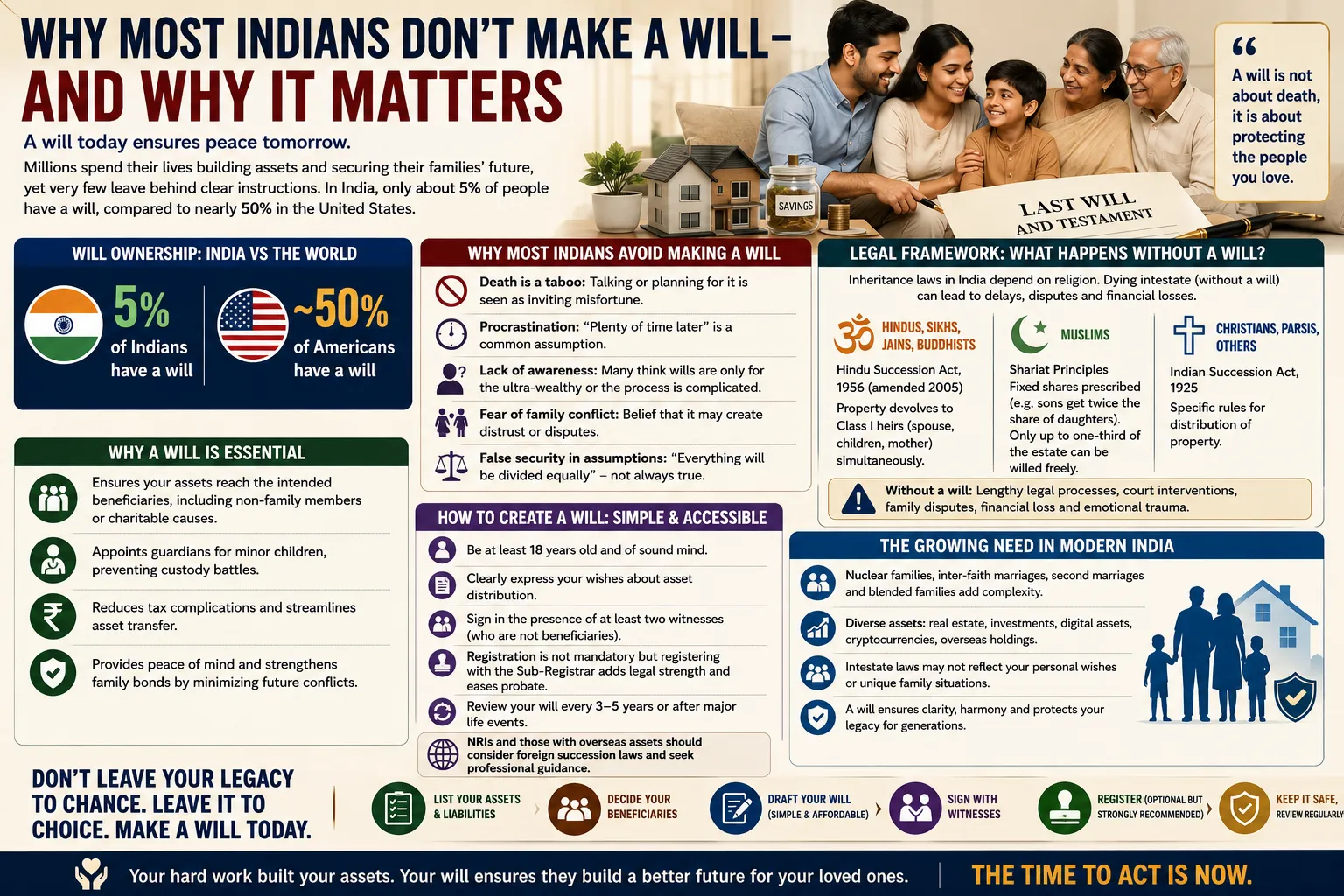
In India, where family remains central to social fabric, the absence of wills creates avoidable complications. Recent surveys indicate that only around 5% of Indians have executed a will, a stark contrast to nearly 50% in countries like the United States. This low figure persists despite increasing wealth accumulation, nuclear families, and complex asset portfolios in the modern era.
Why Most Indians Avoid Making a Will
Several cultural, psychological, and practical reasons contribute to this widespread hesitation. Death remains a taboo subject in many Indian households. Discussing or planning for it is often viewed as inviting misfortune or showing a lack of faith in longevity. Many believe that creating a will signals distrust in family members or tempts fate prematurely.
Procrastination plays a significant role. Most assume there will be “plenty of time later,” underestimating how suddenly life can change. Others hold the misconception that wills are necessary only for the ultra-wealthy. In reality, even modest assets — a flat, vehicle, savings, or digital investments — warrant proper distribution instructions.
Lack of awareness about the legal process further discourages people. Many fear complex procedures, high legal fees, or family conflicts arising from the act of drafting a will. Joint family structures and assumptions that “everything will be divided equally” create a false sense of security. However, without explicit instructions, distribution follows religious personal laws, which may not align with an individual’s wishes.
Legal Framework and Consequences of Dying Without a Will
India does not have a uniform civil code for succession. The rules governing inheritance without a will (intestate succession) depend on religion:
- Hindus, Sikhs, Jains, and Buddhists fall under the Hindu Succession Act, 1956 (amended in 2005 to give daughters equal rights). Property devolves to Class I heirs (spouse, children, mother) simultaneously.
- Muslims follow Shariat principles, where fixed shares are prescribed (e.g., sons typically receive twice the share of daughters), with limited testamentary freedom (only up to one-third of the estate can be willed freely).
- Christians, Parsis, and others are governed by the Indian Succession Act, 1925, which provides specific rules for distribution.
Dying intestate often triggers lengthy probate processes, court interventions, and family disputes. Property can remain locked for years, incurring maintenance costs, legal fees, and emotional strain. In extreme cases, it leads to permanent rifts between siblings or between spouses and children. A properly drafted will simplifies this by clearly naming executors, beneficiaries, guardians for minors, and specific bequests, significantly reducing litigation risks.
The Growing Need in Modern India
India’s rising middle class, increasing nuclear families, inter-faith marriages, and complex financial portfolios (stocks, mutual funds, cryptocurrencies, overseas assets) make wills more relevant than ever. Second marriages, live-in relationships, and blended families add layers of complexity that intestate laws may not address fairly.
A well-crafted will offers multiple benefits:
- Ensures assets reach intended beneficiaries, including non-family members or charitable causes.
- Appoints guardians for minor children, preventing custody battles.
- Reduces tax complications and streamlines asset transfer.
- Provides peace of mind and strengthens family bonds by minimizing future conflicts.
How to Create a Will: Simple and Accessible
Contrary to popular belief, drafting a will is straightforward and inexpensive. A valid will requires:
- The testator (person making the will) to be at least 18 years old and of sound mind.
- Clear expression of wishes regarding asset distribution.
- Signatures of the testator and at least two witnesses (who are not beneficiaries).
While registration is not mandatory, registering a will with the Sub-Registrar provides stronger legal validity and easier probate. Digital tools, online templates, and affordable legal services have made the process more accessible. Periodic reviews (every 3–5 years or after major life events) keep the document relevant.
For NRIs and those with overseas assets, additional considerations like foreign succession laws apply, making professional guidance essential.
Changing the Mindset: Towards Greater Awareness
Financial planners, banks, and legal professionals increasingly emphasize estate planning as part of holistic wealth management. Campaigns highlighting real-life stories of families torn apart by intestate succession can help normalize discussions around mortality and legacy planning.
Younger generations, particularly millennials and Gen Z accumulating assets early, show greater openness to wills. Encouraging open family conversations about inheritance can prevent misunderstandings and promote transparency.
Final Thoughts
The reluctance of Indians to make a will stems from deep-rooted cultural attitudes, lack of awareness, and procrastination. Yet, in an era of growing individual wealth and evolving family structures, a will is no longer optional — it is an act of love and responsibility toward one’s family.
Creating a will does not invite death; it secures peace for those left behind. It transforms hard-earned assets into a legacy of clarity rather than conflict. As India progresses economically, embracing proactive estate planning will become increasingly important for protecting family harmony and financial well-being.
Every individual who has built something meaningful — whether a home, savings, or business — owes it to their loved ones to document their wishes clearly. The time to act is now, while one still has the will to make a WILL.