India Will Keep Buying Russian Oil Despite US Waiver Changes, Says Government Official
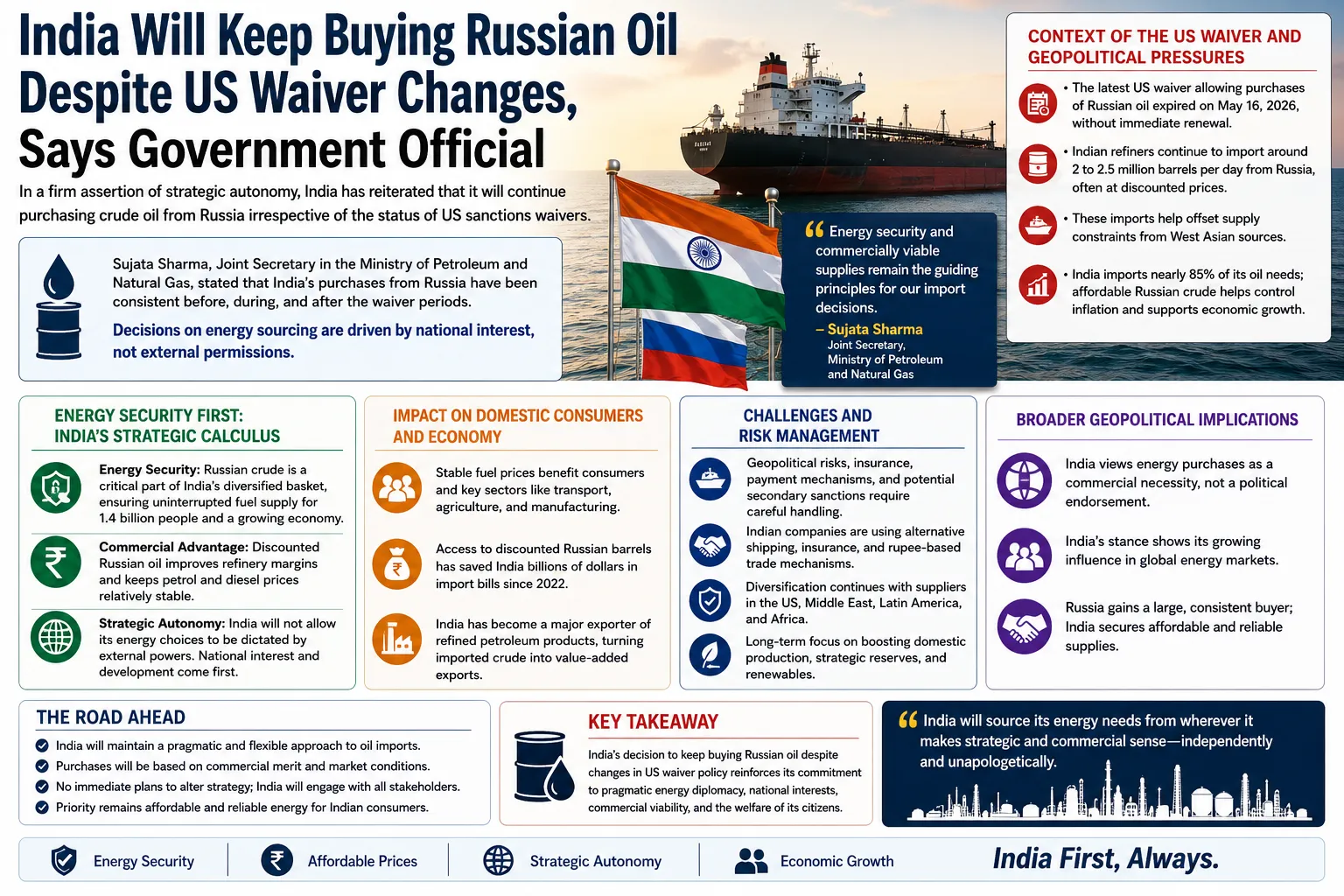
In a firm assertion of strategic autonomy, India has reiterated that it will continue purchasing crude oil from Russia irrespective of the status of US sanctions waivers. A senior government official emphasised that energy security and commercially viable supplies remain the guiding principles for New Delhi’s import decisions, even as global oil markets navigate geopolitical tensions and price volatility. This stance comes amid the recent expiry of a temporary US waiver and ongoing disruptions in West Asian energy routes.
Sujata Sharma, Joint Secretary in the Ministry of Petroleum and Natural Gas, stated that India’s purchases from Russia have been consistent before, during, and after the waiver periods. The government’s position underscores a clear message: decisions on energy sourcing are driven by national interest, not external permissions. This approach reflects India’s long-standing policy of diversified oil procurement to ensure affordable and reliable supplies for its vast population and growing economy.
Context of the US Waiver and Geopolitical Pressures
The United States has periodically issued short-term waivers allowing countries, including India, to purchase Russian oil without triggering secondary sanctions. These measures were often framed as temporary steps to stabilise global energy markets, particularly during disruptions such as the ongoing conflict affecting the Strait of Hormuz. The latest waiver expired on May 16, 2026, without immediate renewal.
Despite these fluctuations, Indian refiners have maintained robust imports from Russia, often routing transactions through non-sanctioned entities and vessels. In recent months, inflows have reached record levels of around 2 to 2.5 million barrels per day, helping offset supply constraints from traditional West Asian sources. Russian crude has frequently been available at discounted prices compared to benchmark grades, providing significant cost advantages to Indian refineries.
India, the world’s third-largest crude importer, relies on imports for nearly 85% of its oil needs. Maintaining access to affordable Russian barrels has been crucial in shielding domestic consumers from sharp fuel price hikes amid global volatility. The government has consistently maintained that buying discounted oil from any source helps control inflation and supports economic growth.
Energy Security First: India’s Strategic Calculus
India’s determination to sustain Russian oil imports stems from several interconnected factors. First and foremost is energy security. With a population exceeding 1.4 billion and rapidly expanding industrial and transportation sectors, uninterrupted fuel supply is non-negotiable. Russian crude has become a critical component of India’s diversified basket, reducing over-dependence on any single region.
Second, commercial considerations play a decisive role. Discounted Russian oil improves refinery margins, enabling competitive pricing of petroleum products. This has helped keep petrol and diesel prices relatively stable in India despite international pressures. Officials have repeatedly highlighted that purchases are based purely on market dynamics, quality, and pricing — not geopolitics.
Third, strategic autonomy remains a cornerstone of India’s foreign policy. Successive governments have asserted that New Delhi will not allow its energy choices to be dictated by external powers. This position aligns with India’s multi-alignment approach, balancing relations with major global players while prioritising national development goals.
Impact on Domestic Consumers and Economy
The continued flow of Russian oil has tangible benefits for ordinary Indians. By blending cheaper Russian crude with supplies from other sources, refiners have managed to maintain stable retail fuel prices. This stability supports transportation, logistics, agriculture, and manufacturing sectors, all of which are sensitive to fuel cost fluctuations.
Economists note that access to discounted Russian barrels has saved India billions of dollars in import bills since 2022, when purchases surged following Western sanctions on Moscow. These savings have indirectly supported fiscal space for welfare schemes and infrastructure development. Moreover, India has emerged as a significant exporter of refined petroleum products, turning imported Russian crude into value-added exports.
Challenges and Risk Management
While the policy brings clear advantages, it is not without challenges. Geopolitical risks, insurance complications for shipments, payment mechanisms, and potential secondary sanctions require careful navigation. Indian companies have adapted by using alternative shipping, insurance, and rupee-based trade mechanisms where possible.
The government continues to monitor global developments closely. Diversification remains key, with efforts to strengthen ties with suppliers in the US, Middle East, Latin America, and Africa. Long-term strategies also include boosting domestic production, expanding strategic petroleum reserves, and accelerating the shift toward renewables and electric mobility.
Broader Geopolitical Implications
India’s firm stance highlights the complexities of global energy politics. While the US has sought to limit Russia’s oil revenues, India views energy purchases as a commercial necessity rather than a political endorsement. This position has occasionally drawn criticism from Western capitals but has also demonstrated India’s growing influence as a major player in global energy markets.
The situation also reflects shifting supply chains. As traditional routes face disruptions, buyers like India play a stabilising role by absorbing available supplies and preventing sharper price spikes that could harm the global economy.
Russia, for its part, has assured India of reliable supplies, further strengthening the bilateral energy partnership. The relationship benefits both nations: Russia gains a large, consistent buyer, while India secures affordable crude.
The Road Ahead
Looking forward, India is expected to maintain a pragmatic and flexible approach to oil imports. Purchases will continue based on commercial merit, with constant evaluation of alternative sources. The government has signalled no immediate plans to alter its strategy, even as it engages in diplomatic conversations with all stakeholders.
For Indian consumers, the priority remains clear: affordable and reliable energy. As global markets evolve, New Delhi’s focus on energy security will likely drive continued diversification while preserving beneficial trade relationships.
In conclusion, India’s decision to keep buying Russian oil despite changes in US waiver policy reinforces its commitment to pragmatic energy diplomacy. By prioritising national interests, commercial viability, and the welfare of its citizens, India navigates a complex geopolitical landscape with strategic clarity. This balanced approach not only safeguards economic stability today but also positions the country to meet its growing energy demands in the decades ahead.
As one of the world’s fastest-growing major economies, India’s energy choices will continue to influence global oil markets and international relations. The government’s recent statement sends a confident message: India will source its energy needs from wherever it makes strategic and commercial sense — independently and unapologetically.
Read more – bestpressnews.com