Why SK Hynix Shares Fell 15% After Nasdaq Debut: Explained
South Korean semiconductor giant SK Hynix attracted strong investor attention after making its debut in the US stock market. The company’s Nasdaq listing initially created excitement among investors, reflecting strong demand for artificial intelligence (AI) chips and growing optimism around the global semiconductor industry.
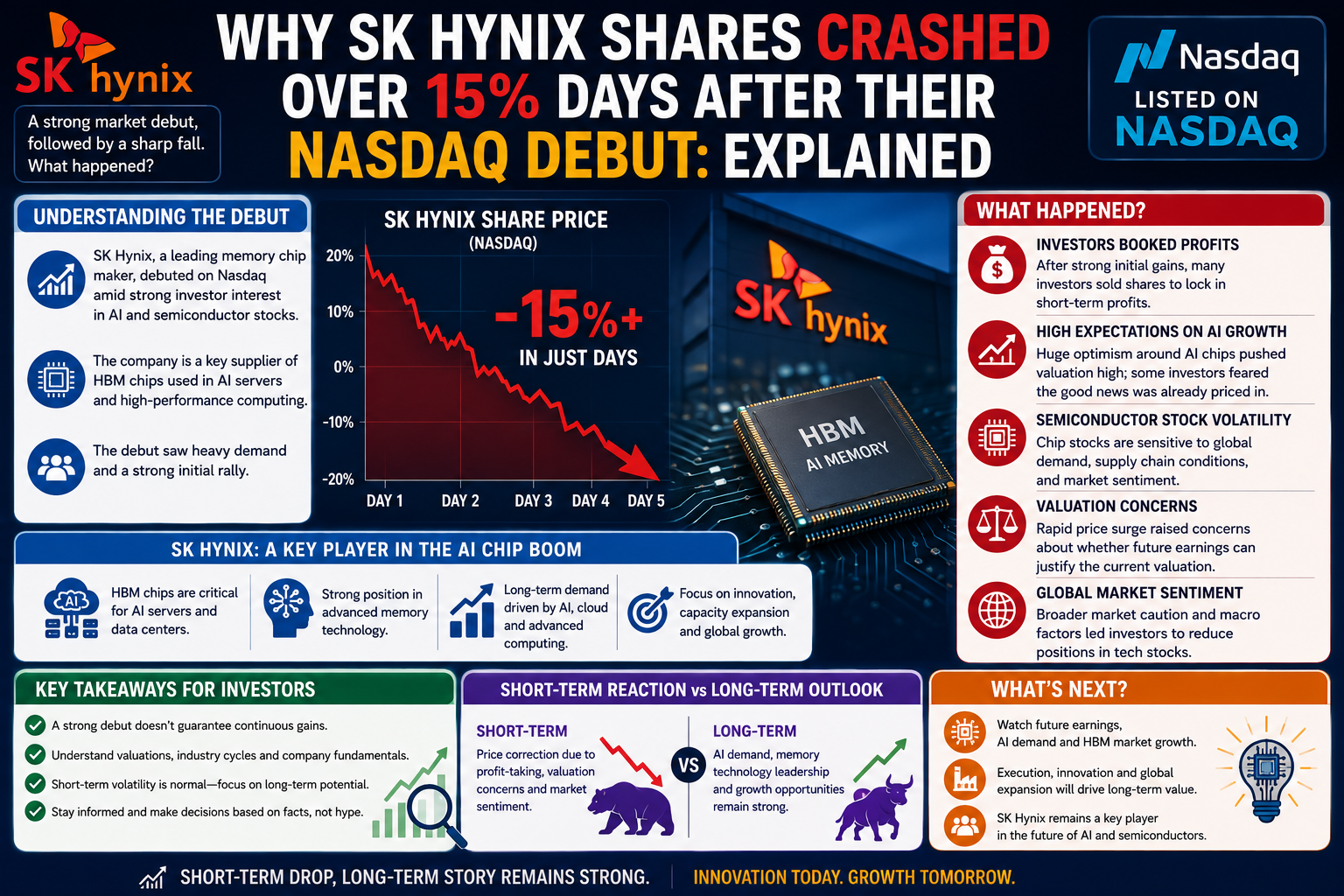
However, the positive momentum was short-lived. Just days after its strong market debut, SK Hynix shares experienced a sharp decline of more than 15% as investors moved quickly to book profits. The sudden fall highlighted the challenges facing semiconductor companies, where high expectations, market valuations, and changing investor sentiment can significantly influence stock prices.
The decline does not necessarily indicate weakness in the company’s long-term business performance. Instead, it reflects a combination of profit-taking, valuation concerns, broader semiconductor market movements, and investor reactions after a major stock market event.
Understanding SK Hynix’s Nasdaq Debut
SK Hynix is one of the world’s leading memory semiconductor manufacturers, particularly known for producing advanced memory products such as High Bandwidth Memory (HBM) chips. These chips have become increasingly important due to the rapid growth of artificial intelligence technologies.
The company’s Nasdaq debut was closely watched because investors have shown strong interest in semiconductor companies benefiting from the AI boom. Demand for AI infrastructure, data centers, and advanced computing systems has increased the importance of companies producing critical chip components.
The strong market response during the initial trading period reflected investor confidence in SK Hynix’s growth prospects. Many investors viewed the company as a key beneficiary of rising AI-related semiconductor demand.
However, after the initial excitement faded, the stock faced selling pressure.
Why Did SK Hynix Shares Fall More Than 15%?
Several factors contributed to the sharp decline in SK Hynix shares after the Nasdaq debut.
Investors Booked Profits After Strong Initial Gains
One of the main reasons behind the sudden drop was profit-taking by investors.
When a stock performs strongly immediately after listing, early investors often sell their shares to secure gains. This creates increased selling pressure, which can lead to a sharp decline in the stock price.
SK Hynix received strong attention during its market debut, causing its valuation to rise quickly. After the initial rally, some investors decided that it was the right time to lock in profits.
This type of correction is common after major listings, especially when investor enthusiasm pushes prices higher in a short period.
High Expectations Around AI Chip Growth
Artificial intelligence has become one of the biggest drivers of semiconductor industry growth. Companies involved in AI chips, memory technology, and data center infrastructure have received significant investor attention.
SK Hynix has benefited from its position as a major supplier of advanced memory chips, especially HBM technology used in AI computing systems.
However, high expectations can also create pressure. When a company’s stock price rises based on future growth predictions, investors often expect strong financial performance to justify those valuations.
If investors believe that future growth is already reflected in the share price, they may reduce their positions, leading to market corrections.
Semiconductor Stocks Face Market Volatility
The semiconductor industry is known for experiencing cycles of rapid growth and sudden corrections. Chip companies often face changing demand patterns, pricing pressures, inventory adjustments, and global economic uncertainties.
Although AI demand has created new opportunities, semiconductor stocks have also become highly sensitive to investor sentiment.
Factors such as:
Global technology spending
Demand for electronic devices
Competition among chip manufacturers
Supply chain conditions
Interest rate expectations
can influence semiconductor stock prices.
SK Hynix’s decline occurred within this broader environment of semiconductor market fluctuations.
Concerns About Stock Valuation
Another factor affecting investor decisions was valuation.
When a company’s stock price rises significantly within a short period, investors often evaluate whether the current valuation matches future earnings potential.
A high valuation means the company must continue delivering strong growth results to maintain investor confidence.
Some investors may have considered the rapid increase in SK Hynix’s share price after its Nasdaq debut as an opportunity to take profits before waiting for future business developments.
Market corrections often occur when investors reassess whether a stock’s price accurately reflects its expected future performance.
The Role of Global Investor Sentiment
Stock markets are influenced not only by company-specific factors but also by overall investor confidence.
Changes in global market sentiment can quickly impact technology stocks. Investors may adjust their portfolios based on expectations regarding economic growth, interest rates, and industry trends.
Technology companies, particularly semiconductor firms, are often among the first sectors affected when investors become more cautious.
A sudden shift in market sentiment can lead to increased selling, even for companies with strong business fundamentals.
SK Hynix’s Importance in the AI Semiconductor Industry
Despite the short-term share decline, SK Hynix remains an important player in the global semiconductor market.
The company has established a strong position in memory technology and has benefited from increasing demand for AI-related hardware.
HBM chips have become a critical component for advanced AI systems because they allow faster data processing and improved computing performance.
As artificial intelligence applications continue expanding, demand for advanced memory solutions is expected to remain a major factor influencing the semiconductor industry.
The company’s long-term performance will depend on its ability to maintain technological leadership, expand production capacity, and respond to changing market conditions.
Short-Term Market Reaction vs Long-Term Business Outlook
A sharp stock price decline after a market debut does not always represent a problem with a company’s fundamentals.
Stock prices can move based on investor expectations, trading activity, and short-term market conditions.
For companies in rapidly growing industries, investors often balance two different perspectives:
The short-term view focuses on price movements, market sentiment, and trading opportunities.
The long-term view focuses on business performance, innovation, competitive advantages, and industry growth.
For SK Hynix, the key question is whether its position in AI-related semiconductor technology can support continued growth over time.
Lessons for Investors From SK Hynix’s Share Movement
The movement of SK Hynix shares highlights several important lessons about investing.
A strong stock market debut does not guarantee continuous price increases. Initial excitement can sometimes push prices beyond levels supported by current business performance.
Investors should carefully evaluate company fundamentals, industry trends, financial performance, and future growth opportunities instead of making decisions based only on market excitement.
Market corrections are a normal part of investing, especially in high-growth sectors such as technology and semiconductors.
Future Outlook for SK Hynix
The future performance of SK Hynix will likely depend heavily on developments in the AI semiconductor market.
Continued demand for artificial intelligence applications, cloud computing, and advanced data centers could support growth opportunities for memory chip manufacturers.
At the same time, the company will need to manage challenges such as competition, production costs, supply chain issues, and changing market demand.
Investors will closely watch the company’s financial results, technology advancements, and ability to benefit from the expanding AI ecosystem.
Conclusion
SK Hynix’s more than 15% share decline shortly after its Nasdaq debut was mainly driven by investor profit-taking, valuation concerns, and changing market sentiment rather than a sudden collapse in the company’s business fundamentals.
The company entered the US market during a period of strong enthusiasm for AI and semiconductor technologies, which helped create significant investor interest. However, rapid gains often lead to corrections as investors reassess prices and future expectations.
While short-term volatility remains a possibility, SK Hynix’s role in advanced memory technology and AI infrastructure keeps it positioned as an important company in the global semiconductor industry. The coming months will show whether the company can convert AI-driven opportunities into sustainable long-term growth.