Chinese Superfast Robot Shows Stunning Speed Before Crashing Into Safety Barrier
A Robot Run That Suddenly Went Wrong
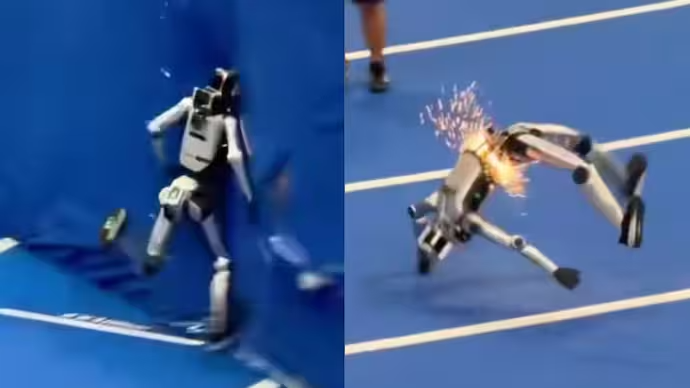
A Chinese humanoid robot has grabbed attention after completing an unusually fast and chaotic running demonstration. The machine appeared to move at an impressive speed before losing control and crashing into a safety barrier during the test. The incident quickly became interesting because it showed both the progress and the problems still facing modern robotic systems.
The demonstration involved a high-speed robot attempting to maintain rapid movement across a controlled testing area. Instead of stopping smoothly at the expected point, the machine continued forward and slammed into the protective wall with considerable force. The robot then appeared to shut down or become unresponsive after the collision.
Videos of robots running at high speeds often look impressive, but demonstrations like this also reveal something important about the engineering challenge. Making a robot move quickly is one problem, while making it understand its surroundings and stop safely is another much harder problem.
Speed Is Not Everything For Robots
The biggest talking point from the incident is clearly the robot’s speed. Modern humanoid robots are becoming capable of increasingly quick movements, including running, jumping, balancing, and changing direction. These abilities require complicated combinations of motors, sensors, software, batteries, and mechanical components working together.
Running creates much greater demands than simply walking across a floor. Every step produces impact forces, while the robot needs to constantly calculate its body position and adjust its balance. Even a tiny delay in sensing or movement can create a major problem when the machine is travelling quickly.
That is why the crash should not simply be viewed as a failure. It also demonstrates how difficult high-speed robotic movement really is. Engineers need to make machines fast enough to perform useful tasks while keeping enough control to avoid dangerous situations.
The Safety Barrier Became The Problem
During the demonstration, the robot apparently reached the end of its running area without stopping as expected. Instead, it moved directly toward the safety barrier and collided with it. The protective wall helped prevent the machine from continuing farther into the surrounding area.
A safety barrier is an important part of testing powerful machines because robotic systems can carry significant mechanical energy when moving rapidly. If something goes wrong, the barrier gives engineers and observers another layer of protection.
The robot’s sudden shutdown after the collision also highlights another concern. A machine designed for fast movement needs reliable emergency systems that can quickly reduce power and bring its body under control when something unexpected happens.
Humanoid Robots Are Getting Faster
The wider robotics industry has been working aggressively on faster and more capable humanoid machines. Companies in China, the United States, Europe, and other regions are developing robots designed to walk naturally, run, carry objects, climb stairs, and operate around humans.
Chinese robotics companies in particular have attracted considerable attention because of their rapid development and frequent public demonstrations. Several firms have showcased humanoid robots performing athletic movements that would have seemed difficult for commercial machines only a few years ago.
Running demonstrations are useful because they test several robotic abilities at the same time. The robot needs accurate perception, strong actuators, stable joints, responsive software, and a powerful control system working continuously.
Why Running A Robot Is Difficult
Human beings naturally adjust their balance hundreds of times while walking or running. Our nervous system processes information from our eyes, muscles, joints, and inner ear almost continuously. A robot has to reproduce a similar process using electronic sensors and computer-controlled systems.
When a robot takes a running step, its control software must consider where the body is positioned, how quickly it is moving, and where the next foot should land. The machine also needs to predict how its momentum will affect the following movement.
This becomes much harder when the robot needs to stop suddenly. Simply switching off the motors could make the robot fall forward rather than stopping safely. Engineers therefore need braking strategies, emergency controls, and movement planning systems capable of responding within very short periods.
The Crash Shows A Bigger Challenge
The incident offers a useful reminder that robotics progress should not be measured only through spectacular demonstrations. A robot completing a fast run can look impressive, but real-world usefulness depends on reliability, safety, and repeatable performance.
A machine working inside a factory cannot simply run quickly and hope everything goes correctly. It must understand obstacles, people, equipment, and changing conditions around it. It also needs to respond safely when sensors provide unexpected information or when something suddenly enters its path.
That makes controlled demonstrations valuable, but they are only one part of the development process. Engineers eventually need to prove that the same systems can operate reliably over thousands of repeated movements without dangerous failures.
Better Sensors Could Help
Advanced sensors are becoming increasingly important for humanoid robots. Cameras, depth sensors, force sensors, inertial measurement units, and other technologies can provide information about the machine’s surroundings and physical position.
A robot running at high speed needs particularly fast feedback. If its sensors detect an obstacle too late, there may simply not be enough distance available for the control system to stop the machine.
Artificial intelligence can also play a growing role in robotic movement. Modern systems can use machine learning to improve balance, predict movement, and respond to different surfaces. Still, AI alone cannot solve every problem, especially when hardware limitations and physical momentum are involved.
China Continues Pushing Robotics Forward
China has become one of the major players in humanoid robotics, with companies investing heavily in machines that could eventually work in factories, warehouses, logistics operations, and other industrial environments.
The country’s manufacturing ecosystem also gives robotics developers access to advanced components, batteries, motors, sensors, and production facilities. That can make it easier to move experimental robotic technology toward larger-scale production.
Fast public demonstrations are partly connected to this competitive environment. Companies want to show that their robots are becoming stronger, quicker, smarter, and more capable than earlier generations.
However, the real competition may eventually focus less on maximum speed and more on reliability. A robot that works safely for eight hours every day could be much more valuable than a machine that runs extremely fast for a few seconds during a demonstration.
What This Means For Future Robots
The unusual running accident does not mean humanoid robots are failing as a technology. In many ways, incidents like this provide engineers with useful information about what needs improvement.
Every high-speed test can reveal weaknesses in motor control, braking, balance, sensing, software coordination, or mechanical design. Those lessons can then be used to improve later versions of the machine.
Future robots are likely to become better at predicting their own movement and understanding nearby obstacles. Emergency stopping systems should also become more sophisticated as robots move into environments where people work alongside them.
The goal will not simply be creating the fastest humanoid robot. The bigger objective will be creating machines that can move quickly when necessary, remain stable under pressure, and stop before an accident becomes unavoidable.
A Short Run With A Big Lesson
The Chinese robot’s spectacular run and sudden collision have created plenty of discussion around the future of high-speed humanoid machines. The footage may look funny or dramatic, but the engineering challenge behind it is serious and complicated.
Robots are entering a stage where physical movement is becoming much more advanced. At the same time, safety systems, perception technology, and real-time control need to improve at the same pace. Speed without control can create obvious risks, especially when machines become powerful enough to operate near people.
For robotics companies, the incident is another reminder that impressive movement must eventually be matched by dependable performance. The next generation of humanoid robots will likely be judged not just by how quickly they can run, but by how intelligently they can react when something goes wrong.
Read More :- jayapokergacor.com
