Bheem: India’s Modular Mars Habitat for Starship
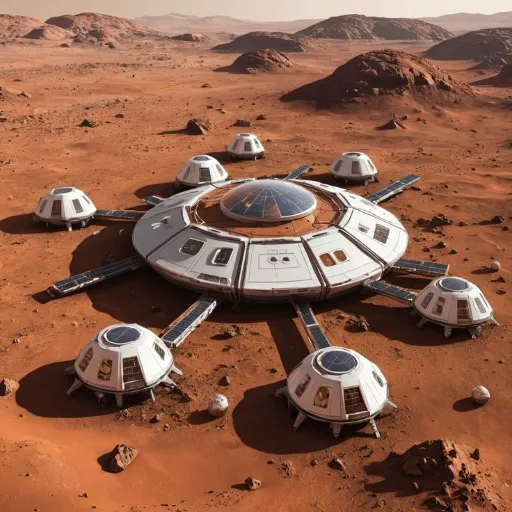
Researchers at the Indian Institute of Science in Bengaluru have proposed an innovative modular habitat concept named Bheem, designed specifically for long-duration human missions to the Moon and Mars. Officially called the Bhartiya Extraterrestrial Expandable Modular Habitat, the design prioritises efficient packing within the payload constraints of large reusable rockets such as SpaceX’s Starship while enabling spacious, expandable living quarters once assembled on the planetary surface.
Understanding the Bheem Concept
Unlike traditional space habitats that launch as bulky, pre-assembled modules, Bheem relies on a panel-based architecture. Individual structural panels—primarily squares, triangles and pentagons—can be stacked compactly inside a rocket’s payload bay. After landing, astronauts or robotic systems assemble these panels into pressurised modules that form complete living and working environments.
The modular approach allows a single Starship payload to deliver a configuration offering approximately twice the habitable volume of the International Space Station. This represents a significant leap in efficiency, addressing one of the core challenges of deep-space exploration: maximising usable living space while minimising launch mass and volume.
Design Priorities and Human-Centred Approach
The research team, which includes Mritunjay Baruah, Amogh Jadhav, Bimalendu Mahapatra and Indian astronaut Shubhanshu Shukla, adopted a bottoms-up, human-centred design methodology. They first analysed the daily activities required on lunar or Martian missions—sleeping, working, exercising, preparing food, personal hygiene and medical care—and calculated the volume needed for each. These requirements then shaped the overall layout.
The resulting habitat supports essential functions within reconfigurable spaces. Modules can be arranged to create private quarters, communal areas, laboratories and exercise zones. Structural analysis has shown that the chosen geometric forms provide high rigidity, with maximum deflection under load remaining extremely low. This ensures the assembled habitat can withstand the stresses of extraterrestrial environments.
Advantages of the Panel-Based System
The panel architecture offers several practical benefits. Because the components travel as flat or near-flat stacks, they fit efficiently within existing heavy-lift payload fairings. Once on the surface, the same modularity simplifies construction, expansion and repair. Damaged panels can be replaced individually rather than requiring an entire module to be abandoned or returned to Earth. Future missions can add new sections as crew size or mission duration increases.
The design is not limited to Starship. The researchers note that the panels can also be accommodated in smaller launch vehicles, making the concept adaptable to a range of mission architectures, including those that may eventually be flown on Indian rockets.
Context Within India’s Space Ambitions
Bheem emerges at a time when India is steadily expanding its human spaceflight capabilities. The Gaganyaan programme aims to send Indian astronauts into low-Earth orbit, while longer-term roadmaps include a national space station and eventual lunar exploration. Concepts such as Bheem extend that vision further by addressing the practical problem of sustained surface habitation.
Related research at the same institute has explored the use of local resources for construction. Experiments with bacteria capable of consolidating simulated Martian soil into brick-like materials demonstrate complementary pathways toward in-situ resource utilisation. Together, modular habitats and locally produced building materials could reduce the mass that must be launched from Earth.
Technical Feasibility and Structural Integrity
Detailed numerical and analytical studies underpin the proposal. The team examined dozens of possible solid geometries formed from simple panel shapes and identified a subset that maximises both packing efficiency and structural performance. Prototype-scale models and finite-element analysis have confirmed that the selected configurations maintain integrity under expected loads.
The habitat is conceived as a pressurised environment capable of supporting normal daily routines. Internal layouts prioritise efficient use of volume while providing psychological relief through varied spaces and the possibility of expansion. External protection against radiation and thermal extremes would rely on a combination of the structural panels themselves and additional shielding, potentially augmented by regolith once on the surface.
Broader Significance for Planetary Exploration
Establishing a permanent human presence beyond low-Earth orbit requires more than transportation systems. Habitats must be reliable, maintainable and scalable. Pre-integrated modules offer simplicity but constrain volume and complicate repairs. Inflatable structures provide volume but present their own challenges in durability and outfitting. Bheem’s panel-based modularity seeks a middle path that combines efficient launch packaging with straightforward on-site assembly and the flexibility to grow or repair the habitat over time.
The concept also aligns with international efforts to develop sustainable architectures for the Moon and Mars. By demonstrating that a large habitable volume can be delivered in a single heavy-lift payload, the design reduces the number of launches required for an initial outpost and simplifies logistics for subsequent expansion.
The Road from Concept to Reality
Bheem remains a research concept rather than a flight-ready system. Realisation would require further development of joining mechanisms suitable for extraterrestrial conditions, rigorous testing of materials under vacuum, radiation and thermal cycling, and integration with life-support, power and thermal-control systems. Nevertheless, the work provides a concrete architectural framework grounded in human factors, structural engineering and launch-vehicle constraints.
Indian researchers continue to explore complementary technologies, including methods for producing construction materials from local regolith. These parallel efforts suggest a systems-level approach in which habitats, building materials and mission architectures evolve together.
Conclusion
Bheem represents a distinctly Indian contribution to the global conversation on planetary habitats. By focusing on modular panels that pack efficiently into large reusable vehicles such as Starship while delivering generous living volume and ease of maintenance, the concept addresses core logistical and human-centred challenges of long-duration surface missions. As space agencies and commercial operators refine plans for sustained lunar and Martian presence, designs like Bheem illustrate how thoughtful architecture can turn the constraint of payload volume into an opportunity for expandable, repairable homes beyond Earth.
Read more – therecipetaste.com , uuploadarticle.com