Strength Training vs Pilates: Which Fitness Method Matches Your Goals
Choosing between strength training and Pilates often depends on individual priorities such as building muscle, improving posture, enhancing mobility or supporting long-term joint and bone health. Both approaches deliver valuable physical benefits, yet they emphasize different qualities. Understanding these differences helps people select the method—or combination—that best aligns with their objectives.
Understanding Strength Training
Strength training, also called resistance training, involves working against external loads such as free weights, machines, resistance bands or body weight in progressive patterns. The primary stimulus for adaptation is mechanical tension. By gradually increasing weight, repetitions or sets over time, muscles experience progressive overload, which drives increases in size and force production.
Research consistently shows that progressive resistance training effectively builds muscular strength and supports muscle growth. It also benefits bone health. Systematic reviews indicate that resistance training can improve bone mineral density, particularly at the hip and femur in older adults and postmenopausal women, helping reduce fracture risk. Additional advantages include better metabolic health, improved functional movement for daily activities and enhanced overall physical capacity.
Because loads can be precisely increased, strength training offers a clear pathway for continued progress in maximal strength and hypertrophy. It places meaningful stress on bones and larger muscle groups, making it especially useful for goals centered on power, muscle mass or skeletal resilience.
Understanding Pilates
Pilates focuses on controlled, precise movements that emphasize core stability, alignment, breath and full-range muscular engagement. Sessions may use a mat or specialized equipment such as a reformer, which provides spring-based resistance. Exercises often challenge muscles through both concentric and eccentric phases while demanding high levels of body awareness and coordination.
Evidence supports Pilates for improvements in flexibility, dynamic balance, posture and muscular endurance. Studies have shown benefits for people with back pain and for correcting postural issues. A review of research found Pilates helpful for posture, particularly among those with back discomfort or scoliosis. Other work indicates gains in muscle function and coordination after consistent practice. Pilates engages deep stabilizing muscles around the trunk, pelvis and shoulders, contributing to better movement control and joint support.
While Pilates can increase strength—especially for beginners or those returning from inactivity—the resistance levels are generally lower and less easily progressed to high loads compared with traditional weightlifting. It builds lean muscle tone and functional endurance more readily than large-scale hypertrophy.
Direct Comparison of Key Outcomes
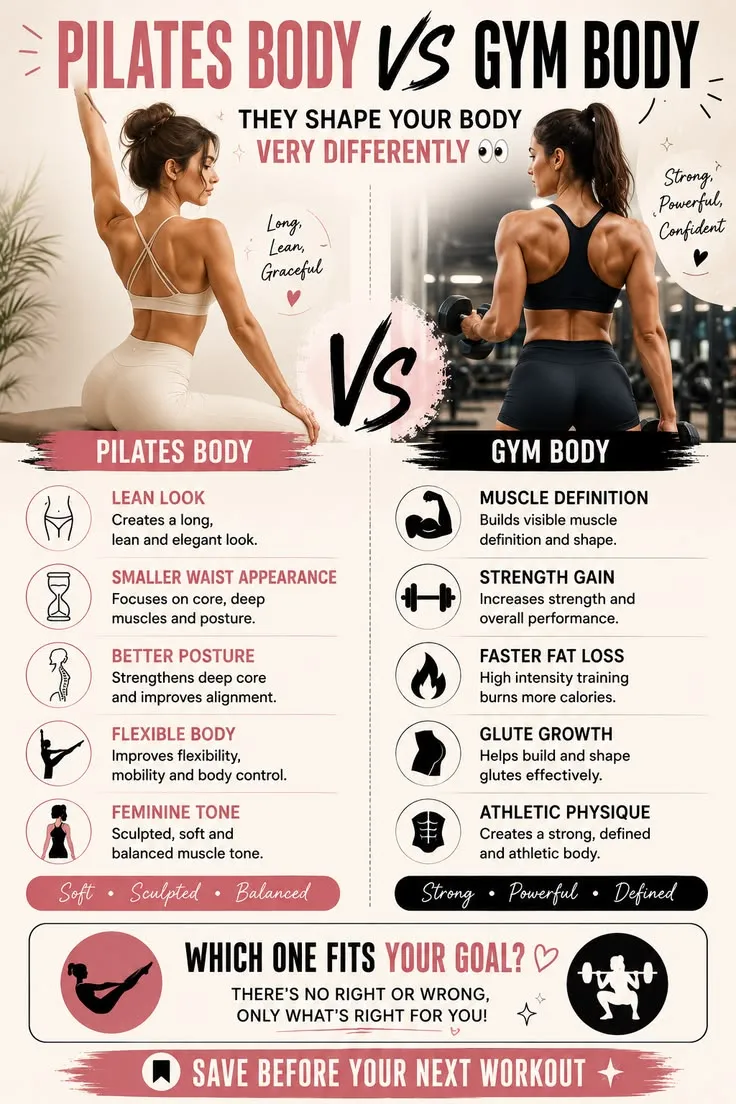
When the goal is maximal muscle size or strength, strength training holds a clear advantage. Progressive overload with heavier loads produces greater mechanical tension, the primary driver of hypertrophy. Pilates can create meaningful strength gains through time under tension and controlled effort, yet the upper limit for muscle growth tends to be lower once the body adapts to the available resistance.
For bone density, resistance training that includes weight-bearing and higher-load movements provides a stronger stimulus. Pilates offers lighter loading that supports joint-friendly movement but does not match the skeletal impact of progressive strength work.
In areas of mobility, posture, balance and core control, Pilates frequently outperforms conventional strength training. Its emphasis on alignment, controlled ranges of motion and deep stabilizers improves body awareness and movement quality. Many people notice better posture and reduced stiffness after consistent Pilates practice.
Both methods can support metabolic health and body composition when paired with appropriate nutrition. Strength training may offer a slight edge for preserving or increasing muscle mass during fat loss because of greater hypertrophic potential. Pilates contributes through improved movement efficiency and adherence for those who prefer lower-impact sessions.
Matching the Approach to Personal Goals
Individuals seeking to build noticeable muscle, increase maximal strength, improve bone density or enhance power for sports or daily lifting tasks generally benefit most from structured strength training. Progressive programs with compound movements such as squats, hinges, presses and rows deliver efficient results.
Those prioritizing posture correction, flexibility, core stability, recovery from back discomfort or refined movement control often find Pilates highly effective. It serves well as a primary practice for people who prefer precise, low-impact sessions or who need to rebuild foundational control before adding heavier loads.
Many fitness professionals note that the two methods complement each other. Pilates can refine movement patterns and strengthen stabilizers that support safer, more effective strength training. Strength training can add the progressive loading that further develops the muscles engaged in Pilates. Combining both within a weekly routine often produces broader physical benefits than either alone.
Practical Considerations for Getting Started
Beginners or those returning after a break may start with Pilates to establish control and body awareness, then gradually introduce resistance training. Others may begin with strength work and add Pilates for mobility and recovery. Consistency matters more than perfection. Both approaches can be scaled to different fitness levels and modified for individual limitations.
Proper form reduces injury risk in either discipline. Working with a qualified instructor or coach, at least initially, helps establish safe technique. Progressive overload remains important for continued adaptation, whether achieved through heavier weights in the gym or more challenging variations and spring settings in Pilates.
Finding the Right Fit
Neither strength training nor Pilates is universally superior. Strength training excels at building muscle mass, maximal strength and bone density through progressive loading. Pilates stands out for posture, balance, flexibility, core control and mindful movement. The most effective choice depends on specific goals, preferences and any existing physical considerations. For many people, integrating elements of both creates a balanced, sustainable approach to fitness that supports strength, mobility and long-term resilience.
Read more – Hairstylespark.com